Amazon Bullet Points: Structure to Sell More and Better SEO

By the Finnex Agency team
TL;DR
- Bullet points aren't decoration — they shape how shoppers scan, understand and decide.
- Structuring them benefit-first with keyword integration improves both SEO and conversion at once.
- Working them alongside title, images and A+ multiplies the effect; isolated, they don't scale.
Many sellers focus on their title, images, and PPC, but treat bullet points as an afterthought.
That's usually a mistake.
On Amazon, bullet points don't just describe the product. They play a key role in how users scan the listing, understand the value, and decide whether to keep moving toward a purchase.
And when done well, they can reinforce listing relevance for specific searches without making the copy feel stiff or artificial.
In this guide, we'll look at how to structure Amazon bullet points so they don't just describe — they help sell more, improve indexation, and support a stronger SEO strategy.
Why Bullet Points Are Still a Critical Part of the Listing
After the title, price, images, and a few initial listing elements, many users quickly scroll to the bullets to answer three specific questions:
- what does this product do
- why should I care
- what makes it different from other options
That's one of the key insights.
Bullet points are one of the first places where a listing can start converting information into perceived value. If they just list isolated features, they lose impact. If they help translate attributes into benefits, use cases, and reasons to buy, the listing starts working harder.
They also serve another important function: organizing the offer in a scannable way. On Amazon, most users don't read linearly. They scan. Compare. Look for quick signals. And if the content doesn't respond fast, it loses traction.
What Makes an Amazon Bullet Point Convert Better
A good bullet point doesn't try to say everything at once.
It does something more useful: takes one important idea and communicates it quickly.
In practice, the bullets that work best tend to share three characteristics.
1. They open with something the buyer cares about
They don't start with a cold specification. They start with an advantage, an improvement, or a clear promise.
2. They back that promise with something concrete
That could be the material, design, construction, compatibility, or a specific feature.
3. They keep the reading simple
The user shouldn't have to decode the text. They should understand it almost instantly.
When a bullet manages to combine benefit, clarity, and real support, the perception of the listing changes.
The Recommended Structure for Writing Bullet Points That Convert
A practical structure that works well across many categories is this:
Main benefit + concrete support + use context or differentiator
This framework helps because it organizes thinking naturally. First, you tell the buyer what they gain. Then you show them why that promise is credible. And finally, you give them context to help visualize the use.
Example:
More stability in every rep: high-density EVA for a firmer base during lower body and mobility exercises.
This doesn't just list a material. It connects the material to a relevant outcome.
How to Distribute the Role of Each Bullet
In many listings, all five bullets are written without a clear logic. That usually leads to repetition.
A better way to think about them is to assign each bullet a distinct function.
| Bullet | Function |
|---|---|
| Bullet 1 | Main benefit or core promise — the strongest reason to buy |
| Bullet 2 | Material, build quality, or perceived quality — what backs that promise |
| Bullet 3 | Use experience or practicality — what it feels like to use the product |
| Bullet 4 | Common objection or functional clarification — what's worth addressing to avoid doubt |
| Bullet 5 | Differentiator or value close — what reinforces the decision |
Not every category will need the exact same order, but this structure goes a long way toward preventing the listing from becoming redundant.
Character Count: Why It Matters More Than Most Sellers Think
This point is often underestimated.
Some listings waste too much space and end up saying very little. Others fill every character without criteria and end up damaging readability.
The goal isn't to use more characters for the sake of it. The goal is to use the available space well.
In practice, that means:
- don't write empty or overly short bullets if there's still real value to communicate
- don't use all available space with heavy or repetitive phrasing
- aim for the right balance between scannability, clarity, and semantic coverage
A listing that uses too little text may be leaving out important arguments, differentiating benefits, or useful terms that could reinforce relevance. But a listing that turns every bullet into a dense block also loses impact — it forces the user to read too much to understand something that should be clear immediately.
How to Use Keywords in Bullet Points Without Breaking the Copy
This is one of the areas where sellers go wrong most often.
They understand that bullet points can contribute to SEO relevance — and that's true. But they interpret it as permission to insert terms mechanically. And that's where the copy breaks down.
The healthier logic isn't "how many keywords can I fit in," but "how do I incorporate relevant terms without sacrificing clarity."
Where it makes sense to use keywords:
It makes sense to include them when they help describe the product, its use, its context, or its relevant attributes. For example: materials, functions, use scenarios, natural language variations, synonyms buyers might use.
What to avoid:
- repeating the same keyword multiple times
- forcing terms that sound unnatural
- writing bullets with only the algorithm in mind
- sacrificing readability for indexation
This matters even more today, because a listing doesn't just need to appear. It needs to read well and respond to the user's intent.
Backend Search Terms: How They Complement the Bullets
Here's another important part of the listing's SEO structure.
Not everything has to live in the visible front-end content. Bullets need to stay readable and commercial. The backend, on the other hand, can help you add coverage without overloading the visible copy.
What works better in backend:
- secondary variations
- terms that aren't essential for the front
- useful search combinations
- complementary vocabulary that doesn't improve the visible experience but can add coverage
Common mistake: because sellers want to index for more terms, they force too many keywords into the bullets and end up breaking the readability. In many cases, part of that load should be handled in the backend — while the visible front stays clear, commercial, and well structured.
How to Think About Indexation Today
Amazon doesn't publish a closed formula for its search algorithm, so it's not worth writing as if there were an exact official rule.
But there is a fairly consistent logic in how to think about content today:
- visible content helps reinforce relevance
- listing clarity improves readability and experience
- alignment between search, text, and product helps better answer intent
- the backend can add extra coverage
- the listing's ability to generate clicks, purchases, and performance signals remains central
That nuance changes how you write bullets. Having terms in the bullet is no longer enough. It needs to quickly answer: what does the product do, why does it matter, who it's for, and why this option deserves attention.
Common Mistakes When Writing Amazon Bullet Points
One of the most common mistakes is talking only about features. When bullets list attributes without translating them into benefits, the listing loses commercial impact.
Another frequent error is using generic phrases. Expressions like "high quality," "premium design," or "easy to use" sound fine but say little if they're not developed further.
It also happens a lot that all bullets say roughly the same thing. Some words change, but the function doesn't.
Another very typical problem is keyword stuffing. The text starts to sound artificial, loses clarity, and signals less professionalism.
And finally, many listings fail because bullets are never updated over time. Sellers adjust campaigns, budgets, and creatives — but don't revisit whether the copy still accurately represents the product, the search intent, and the buyer.
Examples: Weak Bullets vs. Better-Structured Bullets
Weak version
- EVA material
- Non-slip design
- Easy to carry
Not bad factually. But it communicates little.
Improved version
- More stability during exercise: high-density EVA for a firm and secure base
- Better grip every time: textured surface designed to reduce slipping
- Practical for gym or home: lightweight format that's easy to store between sessions
The difference isn't that the second version sounds nicer. The difference is that it helps sell more. The first version describes. The second interprets, organizes, and communicates value.
Another example, more SEO-focused
Weak version:
Squat wedge for squats, squat wedge gym, anti-slip squat wedge
That feels forced. It has terms, but no clarity.
Improved version:
Better squat posture: design built to support mobility, activation, and lower body strength training
Here you're still relevant to the category, but the reading experience improves significantly.
2026 Best Practices for Amazon Bullet Points
1. More clarity, less filler
The copy needs to scan quickly. If understanding the value requires too much reading, the bullet loses impact.
2. Benefit first, support second
Buyers connect more readily with an improvement than with an isolated specification.
3. Keywords yes, but with criteria
Integrating them naturally is still far better than repeating them without control.
4. The listing needs to work as a system
Bullets don't work alone. They need to be aligned with: title, images, A+ Content, price, reviews, visual proposition, and product positioning.
5. Backend doesn't replace the front — it complements it
Backend search terms can add coverage, but shouldn't be used as an excuse to neglect visible content.
6. Improving bullets shouldn't be a one-time thing
As buyer questions evolve, relevant searches shift, or market understanding deepens, listing copy should evolve too.
Checklist to Review Whether Your Bullet Points Are Really Helping You Sell
Before finalizing your listing, it's worth checking:
- Does the first bullet open with the strongest benefit?
- Does each bullet serve a distinct function?
- Is the reading fast and clear?
- Does the text sound natural?
- Are keywords integrated with intention?
- Are you using the available space well without overloading?
- Do the bullets address real buyer questions?
- Is there real differentiation or just basic description?
- Are the bullets aligned with the images and title?
- Did you leave secondary coverage for the backend rather than forcing it into the front?
If several of those answers today are "kind of," there's probably a real improvement opportunity sitting right there.
Conclusion
On Amazon, bullet points shouldn't exist to fill space in the listing.
They should help the user quickly understand what the product does, why it matters, and why it's worth continuing toward a purchase.
When well structured, they can reinforce perception, clarity, relevance, and indexation at the same time.
And in an environment where listings increasingly compete not just to appear, but to better respond to user intent, writing good bullets is no longer a minor detail.
It's become a central part of how products sell.
If your listing has traffic but isn't converting, the problem is often not just the PPC or the product. It may also be in how you're communicating value. At Finnex, we analyze listings with a focus on conversion, clarity, and strategic structure. You can request a strategic audit and pinpoint exactly where the real opportunity is.
Keep reading

How to Optimize Amazon Images to Increase Sales
Complete guide to creating images that increase conversion in your Amazon listings: visual structure, storytelling, and common mistakes to avoid.
Read more →
7 Amazon Listing Mistakes Killing Your Conversion Rate
7 common Amazon listing mistakes that lower your conversion rate, with concrete fixes for main image, title, bullets and A+ Content.
Read more →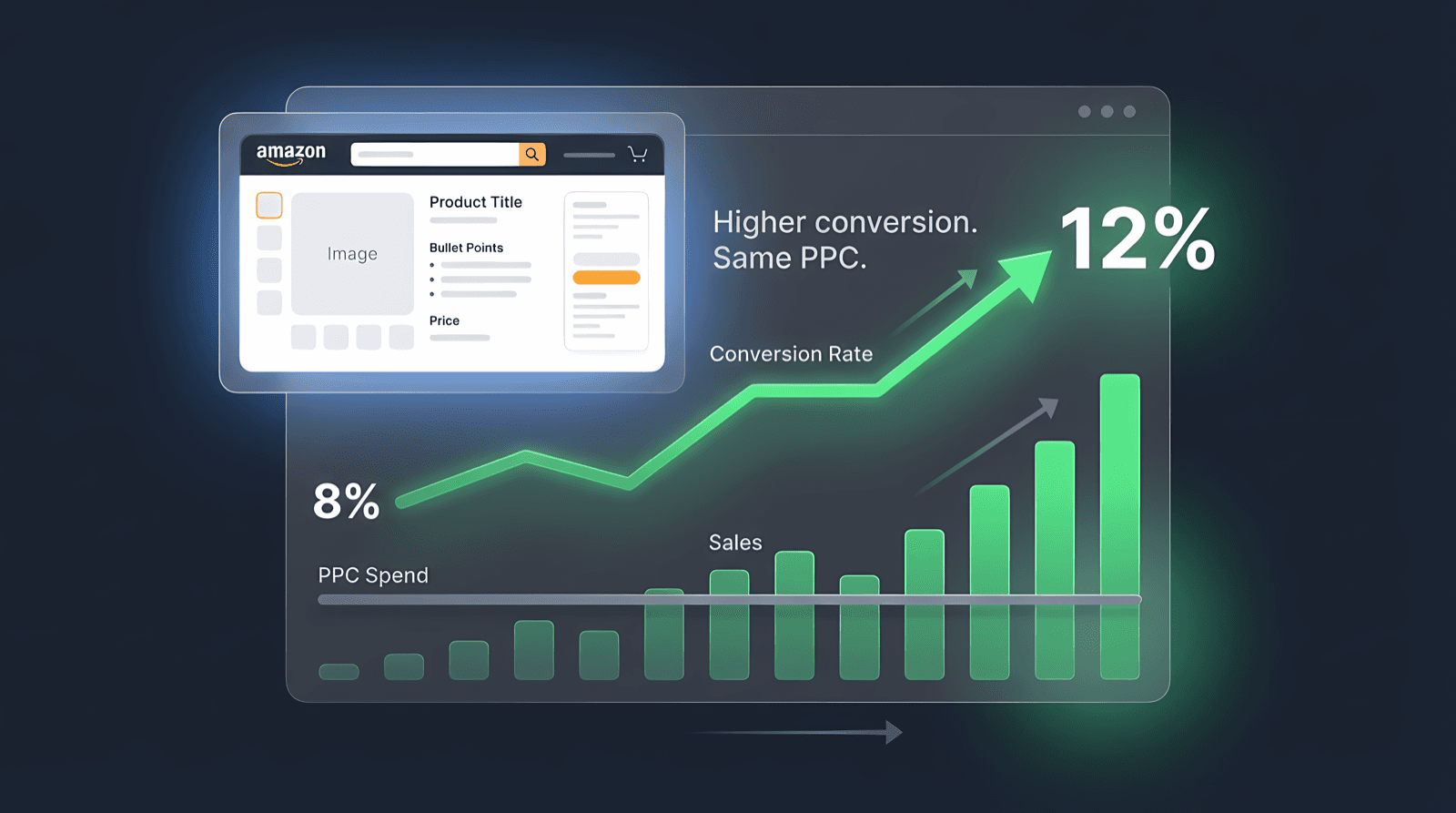
Improve Amazon Conversion Without Raising Your PPC Budget
Learn how to optimize your Amazon conversion rate (CVR) without raising ad spend: images, bullets, reviews, and perceived value to sell more efficiently.
Read more →