Defend Your Brand on Amazon Ads Without Inflating Spend

By the Finnex Agency team
TL;DR
- Defending your brand on Amazon isn't about raising budget — it's about having a separate, well-structured branded campaign.
- Without a brand-defense campaign, competitors capture super high-intent traffic for pennies.
- It's the cheapest, highest-ROAS investment in the account: usually 5-10% of spend, returns 3-4x more than the average.
You have Brand Registry active. Your product is well positioned. And yet, when someone searches for your brand on Amazon, the competition shows up before you do. The immediate reflex is to raise the budget. The problem is that this reasoning starts from the wrong premise: defending your brand isn't a matter of spend. It's a matter of structure.
01 — Why competitors show up when people search for your brand
Amazon Ads has no automatic restrictions on which keywords each advertiser can bid on. Any seller can bid on a competitor's brand name. And many do.
The user who types your brand name has already made a purchase decision. They're not browsing. If at that moment the competition shows up and your brand doesn't, you're paying with organic ranking what they capture with advertising.
Where does this hurt you exactly?
| Impact | What it means in practice |
|---|---|
| Lost sales | Users who searched for your name and bought from a competitor |
| Higher TACoS | You pay more in ads to recover sales that should have come in on their own |
| Organic position at risk | Fewer conversions → worse ranking → less visibility → negative cycle |
| Customers that don't come back | If the first touchpoint was with another seller, they get the repeat purchase too |
I have Brand Registry and I still have this problem?
Yes. And it's the most common mistake. Brand Registry gives you access to tools like A+ Content, Sponsored Brands, and listing protection. But it doesn't activate any campaign automatically. Registering your brand doesn't protect your name in Ads search results.
| Tool | What it does | What it does NOT do |
|---|---|---|
| Brand Registry | Protects the listing, enables content tools | Doesn't block competitor ads on branded searches |
| Brand defense campaign | Takes the ad space when someone searches your name | Doesn't replace Brand Registry |
02 — How a brand defense campaign works
A brand defense campaign is a campaign configured exclusively to appear when someone searches for your name. It's built with two formats:
SP — Sponsored Products
The foundation — shows up in search results.
When someone types your brand. It's the first thing to activate. Doesn't require Brand Registry.
SB — Sponsored Brands
The header — premium visual real estate.
Logo, headline, and products at the top of the page. Requires Brand Registry active.
Golden rule: one campaign, one objective. When you mix them, the data gets contaminated and decisions get made on incorrect information.
03 — Why it's the cheapest investment in the account
Most sellers think defending the brand is an extra cost. It's exactly the opposite.
| Factor | Generic campaign | Brand campaign |
|---|---|---|
| User intent | Exploring options | Already decided to search for your brand |
| Conversion rate | Category standard | 2x to 4x higher |
| CPC (cost per click) | Competitive, usually high | Generally lower |
| Auction competition | High | Lower — you're the most relevant |
| Expected ROI | Variable | Consistently high |
Concrete example
Spending $50 defending your brand at 8% ACoS is more efficient than spending $500 on generic campaigns at 35% ACoS. The user searching your name is already convinced. They just need to find you.
04 — The 4 mistakes that ruin a brand defense campaign
Having the campaign active isn't enough. These are the most common mistakes that burn budget without protecting anything.
MISTAKE 1 — Wrong match type: Broad instead of Exact
What happens: With Broad Match, Amazon can show your ad on searches that barely resemble your brand. The budget scatters across irrelevant traffic.
The fix: Brand defense always uses Exact Match. In some cases, Phrase Match. Broad never.
MISTAKE 2 — Not covering name variations
What happens: Users don't always spell the brand perfectly. Typos, abbreviated versions, the product name without the brand.
The fix: Review the Search Term Report filtered by brand and identify every variant with volume.
MISTAKE 3 — Insufficient daily budget
What happens: The campaign runs out of funds at 2 p.m. The rest of the day, your name is open for the competition to capture.
The fix: If there are budget constraints, the brand campaign is the last one that should be cut.
MISTAKE 4 — Mixing brand keywords with generic keywords
What happens: The data gets contaminated. Brand keywords convert much better, so the average ACoS looks artificially low.
The fix: A separate campaign just for the brand. No exceptions.
05 — How brand defense connects with TACoS
Brand defense has a direct impact on TACoS. When the campaign is active and well configured: branded keywords capture high-intent traffic → those conversions add to total sales → the TACoS denominator grows without ad spend scaling proportionally.
| Scenario | TACoS | Correct reading |
|---|---|---|
| No brand campaign, active competition | Apparently low | ⚠ False positive: traffic is leaking without showing up in reports |
| Campaign active and well structured | Controlled | ✓ Low spend, high conversion, traffic stays inside your account |
| Campaign with Broad Match and poor budget allocation | Variable and confusing | ✗ Contaminated data. TACoS doesn't reflect reality |
06 — When to review (and when to leave it alone)
| ⚠ SIGNS TO REVIEW | ✓ SIGNS OF GOOD CONFIGURATION |
|---|---|
| Impression Share drops with no explanation | Brand ACoS below breakeven |
| Brand ACoS rises | Impression Share stable and high |
| Organic sales drop but traffic doesn't | Brand CPC lower than generic campaigns |
| Competitors appear in the brand Search Term Report | No spend on irrelevant terms |
07 — Checklist: the bare minimum that must be active
- SP campaign active with brand keywords in Exact Match
- Daily budget sufficient to cover peak hours
- SB campaign configured (if Brand Registry is active)
- Brand keywords as negatives in every generic campaign
- Monthly review of the Search Term Report filtered by brand
Frequently asked questions
Can I defend my brand without Brand Registry?
Yes. With Sponsored Products in Exact Match you can cover branded searches without Brand Registry. Sponsored Brands does require active registration.
How much budget does this campaign need?
Depends on the volume of branded searches in your category. The Search Term Report is the best reference. It must be enough not to run out during peak traffic hours.
Do I need to bid very high to win the auction on my own name?
Not necessarily. The brand owner's Quality Score is usually higher due to relevance. In many cases you win the position with a lower CPC than the competition.
How do I know if a competitor is bidding on my brand?
By reviewing the Search Term Report and the Auction Insights report. If competitors appear on exact brand searches, that's direct confirmation.
How often should these campaigns be optimized?
Less often than generic ones. Once well configured, they tend to stabilize. The monthly review of the Search Term Report and monitoring Impression Share are enough in most cases.
To close
Every sale lost on a search for your own brand name is a sale the account built —with images, reviews, organic ranking— and that another brand captured at the last step. It's not a product problem. It's not a price problem. It's an ad-structure problem with a concrete fix.
Three takeaways
Brand defense is the lowest-cost, highest-return layer in the entire account.
It doesn't depend on how much you spend — it depends on how it's configured.
Without it, some of the most valuable traffic in your account is working for the competition.
If your account has Brand Registry but no brand campaigns set up, at Finnex we audit the real structure of your campaigns, the Search Term Report filtered by brand, and the exact points where conversions that should stay in your account are being lost. You can request your PPC audit and get a diagnosis within 48 hours.
Keep reading
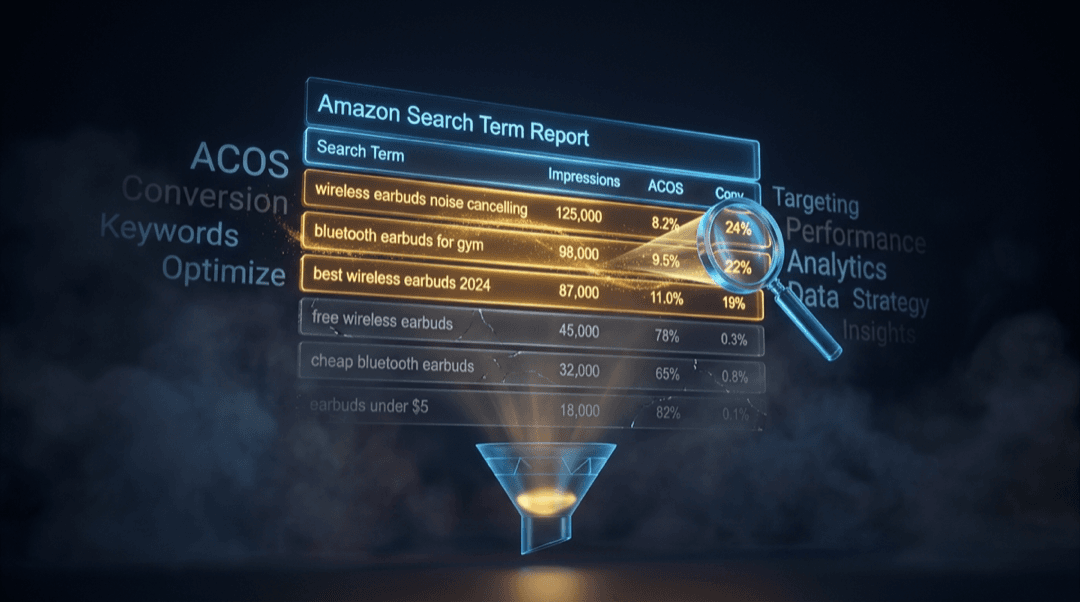
How to Analyze the Search Term Report Correctly
The Search Term Report shows what shoppers actually searched. Learn to read it with the 4-quadrant framework and optimize your Amazon PPC.
Read more →
Amazon Ads Scaling Strategy: From Campaigns to Growth
How to move from active campaigns to a real Amazon Ads scaling system: structure, the PPC-organic flywheel, inventory, and TACoS.
Read more →
How to Tell if Your Amazon PPC Is Poorly Structured
Your account can be running campaigns and still be poorly structured. 8 signals that something is broken in your Amazon Ads before scaling spend.
Read more →