Alexa for Shopping: How Amazon's AI Picks Products (and What Supplement Brands Should Change)
By the Finnex Agency team
Before you start: the key points
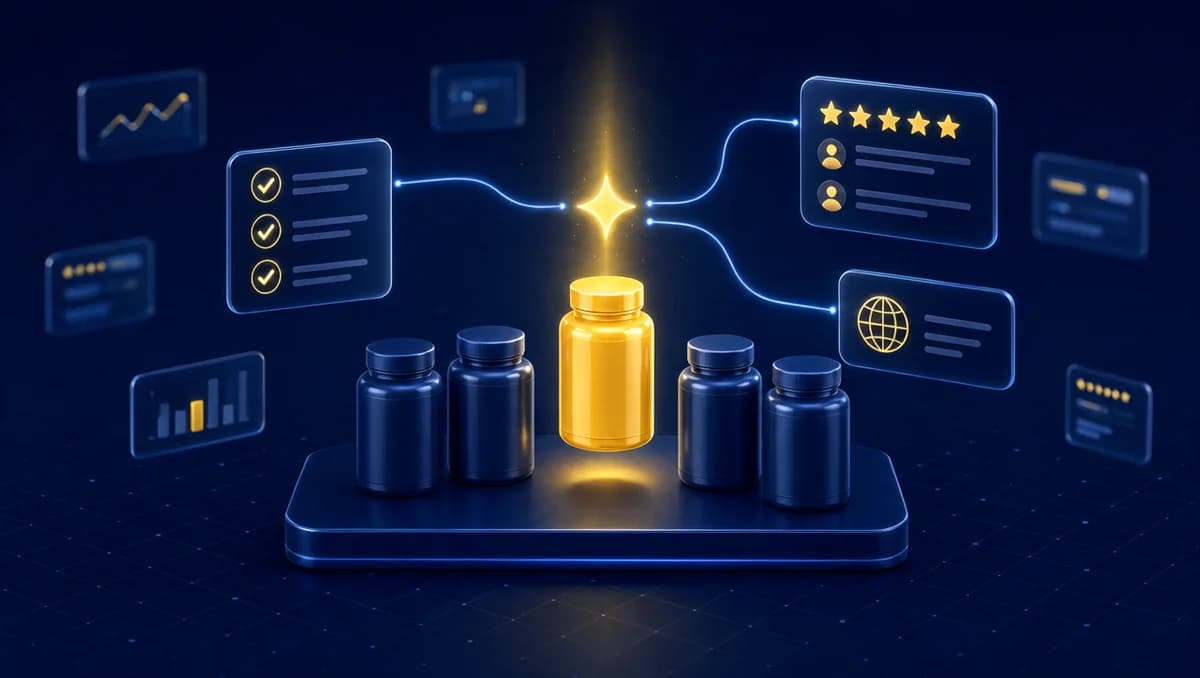
Alexa for Shopping is the AI assistant that replaced Rufus on Amazon US on May 13, 2026. It lives in the search bar, compares products, shows price history, and can buy automatically when a price drops to a target the shopper sets. To decide what to recommend, it combines what is on your listing (catalog data, reviews) with web information and each shopper's history.
If you are short on time, this is what matters:
- It is not an experiment. On its October 29, 2026 earnings call, Amazon said more than 400 million customers used Alexa for Shopping in the past 12 months. Andy Jassy added that users spend 50% more than non-users.
- Your listing is the raw material. The assistant answers from catalog data, reviews and the web. An empty attribute is a question it cannot answer in your favor.
- Your pricing is now visible. Any shopper can see up to 365 days of your product's price history.
- Ads are already inside. Sponsored Prompts have been billed per click in the US since March 25, 2026.
- It is not in the UK yet. Amazon has not announced a date, but UK listings should be prepared now.
From Rufus to Alexa for Shopping: what changed and when
Rufus launched in February 2024 as a chat for researching products on Amazon. In May 2026, Amazon merged it with Alexa+ and renamed it. The change is more than branding: Rufus answered questions, while Alexa for Shopping also takes actions for the shopper.
| Date | What happened |
|---|---|
| Feb 2024 | Amazon launches Rufus in the US. |
| Oct 30, 2025 | Jassy reports 250 million Rufus users in 2025. Amazon says Rufus users are 60% more likely to complete a purchase and expects over $10 billion in annual incremental sales. |
| Nov 2025 | Sponsored Prompts enter open beta. |
| Mar 25, 2026 | Sponsored Prompts reach general availability in the US and start being billed. |
| May 13, 2026 | Rufus merges with Alexa+ and becomes Alexa for Shopping across the app, website and Echo Show. |
| Sep 2026 | Beta launch in the UAE, the first market outside the US. Amazon reports 350 million users in 12 months. |
| Oct 29, 2026 | Amazon adds 100+ new capabilities and reports 400 million+ users in 12 months. Use of agentic features is up 8x since the start of 2026. |
For shoppers, the biggest change is that the assistant acts. It can set an auto-buy at a target price, schedule restocks, build a cart from a photo of a handwritten list and, since October 29, change a Subscribe & Save frequency with one sentence. With Buy for Me, it can even complete purchases on other retailers' sites. We cover the rules behind each of these automatic purchases in Buy for Me and Auto Buy: when AI buys on Amazon.
Shoppers do not need Prime or an Echo device. It is free for any signed-in customer on Amazon US, which is why its reach is so large.
How it decides what to recommend
Amazon does not publish the assistant's ranking algorithm. It has published the sources it uses and the mechanisms it was built on, and that is enough to know which parts of your account carry weight.
1. A model trained on shopping data
Trishul Chilimbi, who led the team that built the model behind Rufus, explained in IEEE Spectrum that Amazon did not adapt a generic model. It trained its own from scratch on the Amazon catalog, customer reviews, community Q&A and public web information. That is why the assistant reasons in attributes, uses and customer opinions, not in isolated keywords.
2. It searches several sources before answering
When a question goes beyond what the model knows, the system uses retrieval-augmented generation (RAG). It parses the question, picks which sources to query (catalog, reviews, community Q&A or store APIs) and only then builds the answer. Each source carries different weight depending on the question. "Does this magnesium contain sugar?" is answered from your attributes and description. "Was it easy on people's stomachs?" is answered from your reviews.
3. It knows who a product is for and what it is for
In May 2024, Amazon Science published COSMO, a system that uses language models to build a "common sense" knowledge graph from real searches and purchases. It links products to their use, occasion and audience, for example slip-resistant shoes to pregnant women. In search relevance tests, the COSMO-enhanced model beat the best baseline by more than 20% in F1. Amazon has not publicly confirmed that the assistant uses COSMO, but it shows where Amazon search is heading: from keyword to intent.
4. It personalizes with each shopper's history
According to the official announcement, Alexa for Shopping draws on Amazon product knowledge, web information, the shopper's preferences, purchase history and conversations with Alexa. In August 2026, Amazon shared examples where the assistant used past orders, browsed products and even a photo of a shopper's fridge. Two people asking the same question can get different recommendations.
5. It learns from shopper feedback
Every answer has a thumbs up and a thumbs down. According to Chilimbi, that signal feeds a reinforcement learning process that refines answers over time. Amazon does not detail how it affects individual products, but the incentive is clear: answers that leave shoppers satisfied.
What shoppers see as a result are AI overviews at the top of search and on product pages, side-by-side comparisons of features, price and reviews, and a "Why you might like this" block that explains why a product fits them.
What to change in your supplement listing
None of this replaces classic Amazon SEO: traditional search still runs alongside the assistant. What changes is that your listing now also has to answer questions. These levers come straight from the sources above.
Fill in every catalog attribute
The catalog is the first source the assistant checks. If your listing does not declare the form (capsule, powder, gummy), dose per serving, servings per container or whether it is vegan, the assistant cannot use that to pick you. Review the optional attributes in Seller Central, not just the required ones. For supplements, that is usually where shoppers' questions live.
Write bullets that say who it is for and when to take it
If search is moving from keyword to intent, a bullet that says "take before bed" or "formulated for women over 40" gives the assistant context. Always within what the FDA allows on a supplement: a health claim you cannot support is a compliance risk, not an SEO win. For the full method, see our guide to Amazon bullet points.
Read your reviews the way the AI does
Side-by-side comparisons include reviews, and the assistant checks them to answer experience questions. A repeated pattern ("felt heavy on my stomach", "strong taste") becomes part of the answer. Look for those patterns every month and fix them in the product or on the listing, for example by noting it is best taken with food.
Make your brand say the same thing everywhere
The assistant also uses web information. If your website says 400 mg and your listing says 500 mg, you are giving it two truths to choose from. Aligning your site, listing, Amazon Store and social channels is the cheapest fix available today.
Review your pricing with the history in plain view
Price history shows 30, 90 or 365 days, using the lowest Featured Offer price each day, shipping included. A discount off a previously inflated price is easy to spot. Shoppers can also schedule an auto-buy at a target price, so your promotions now compete with that alert, not just with competitors.
Protect Subscribe & Save
Since October 29, 2026, shoppers can change their subscription frequency or skip a delivery by asking the assistant. For supplements, where repeat purchase is the business, that lowers friction both ways. Track subscriber retention month by month from now on.
Ads are already inside the assistant: Sponsored Prompts
Sponsored Prompts are AI-generated suggestions that appear in search results and on product pages. When a shopper clicks one, it opens a conversation with the assistant about your product. Amazon calls them a "24/7 virtual product expert."
What you need to know, per Amazon Ads' official announcement:
- They switch on automatically. Eligible Sponsored Products and Sponsored Brands campaigns were enrolled with no setup.
- They are billed per click since March 25, 2026, within the campaign's CPC. There is no separate bid.
- They are built from your listing. Amazon uses your detail page, Brand Store and campaign data. A weak listing produces weak prompts, and you still pay for them.
- They have their own report. In the Ads Console, under Reports, the Prompts report shows impressions, clicks, CPC, spend, sales, ACOS and ROAS per prompt. You can pause the ones that underperform.
- US only, for now.
If you run US campaigns and have never opened that report, start there. It is spend you are already making. To check whether your PPC is set up for this, request a free audit.
What if you sell in the UK?
As of this article, Amazon has not announced Alexa for Shopping for amazon.co.uk. Seller Central limits it to the United States, and the first market outside the US was the UAE, in beta, in September 2026. Alexa+ is already available in the UK, so the infrastructure is in place.
Our recommendation is to prepare your UK listing with the same criteria as your US one. Complete attributes, consistent information and well-managed reviews improve conversion today, with or without the assistant. When it arrives, your listing will be ready instead of catching up.
Frequently asked questions
What happened to Amazon Rufus?
Rufus did not disappear. On May 13, 2026, it merged with Alexa+ and became Alexa for Shopping in the US. It keeps what Rufus did and adds actions such as auto-buy at a target price, scheduled restocks and subscription management.
How many people use Alexa for Shopping?
More than 400 million customers in the past 12 months, according to Amazon's October 29, 2026 earnings call. Andy Jassy added that users spend 50% more than non-users.
Can you pay to appear in the assistant's answers?
Not directly in the answer, but you can through Sponsored Prompts: AI-generated suggestions that open a conversation about your product. They have been available in the US since March 25, 2026, are billed per click and switch on automatically in eligible campaigns.
Should you stop optimizing for keywords?
No. Traditional search still runs alongside the assistant. What you add is optimizing for questions: complete attributes, bullets that state use and audience, and reviews that answer real concerns.
Is Alexa for Shopping available in the UK?
Not as of October 2026. Amazon launched it in the US and in beta in the UAE, and has not announced a date for the UK.
Wrapping up
Alexa for Shopping does not replace Amazon search, but it adds someone who reads your listing before the shopper does. That reader uses your attributes, reviews, pricing and what the web says about your brand, then decides whether you are worth showing. With 400 million+ users, it is no longer a niche feature.
For a supplement brand, the good news is that almost everything the assistant values also lifts traditional conversion. Complete listings, consistent information and coherent pricing are not extra work: they are the work that had to be done anyway.
This content reflects public information verified as of October 30, 2026.