Improve Amazon Conversion Without Raising Your PPC Budget
By the Finnex Agency team
TL;DR
- If your product gets visits but doesn't convert, the problem isn't traffic — it's the listing.
- Optimizing images, bullets, A+, reviews and value perception lifts CVR without touching budget.
- Higher conversion = lower ACOS + better organic ranking. It's the highest-ROI change you can make.
Many sellers try to increase Amazon sales by raising their Amazon Ads budget.
Yet real, sustainable growth in Amazon FBA doesn't start with traffic — it starts with conversion.
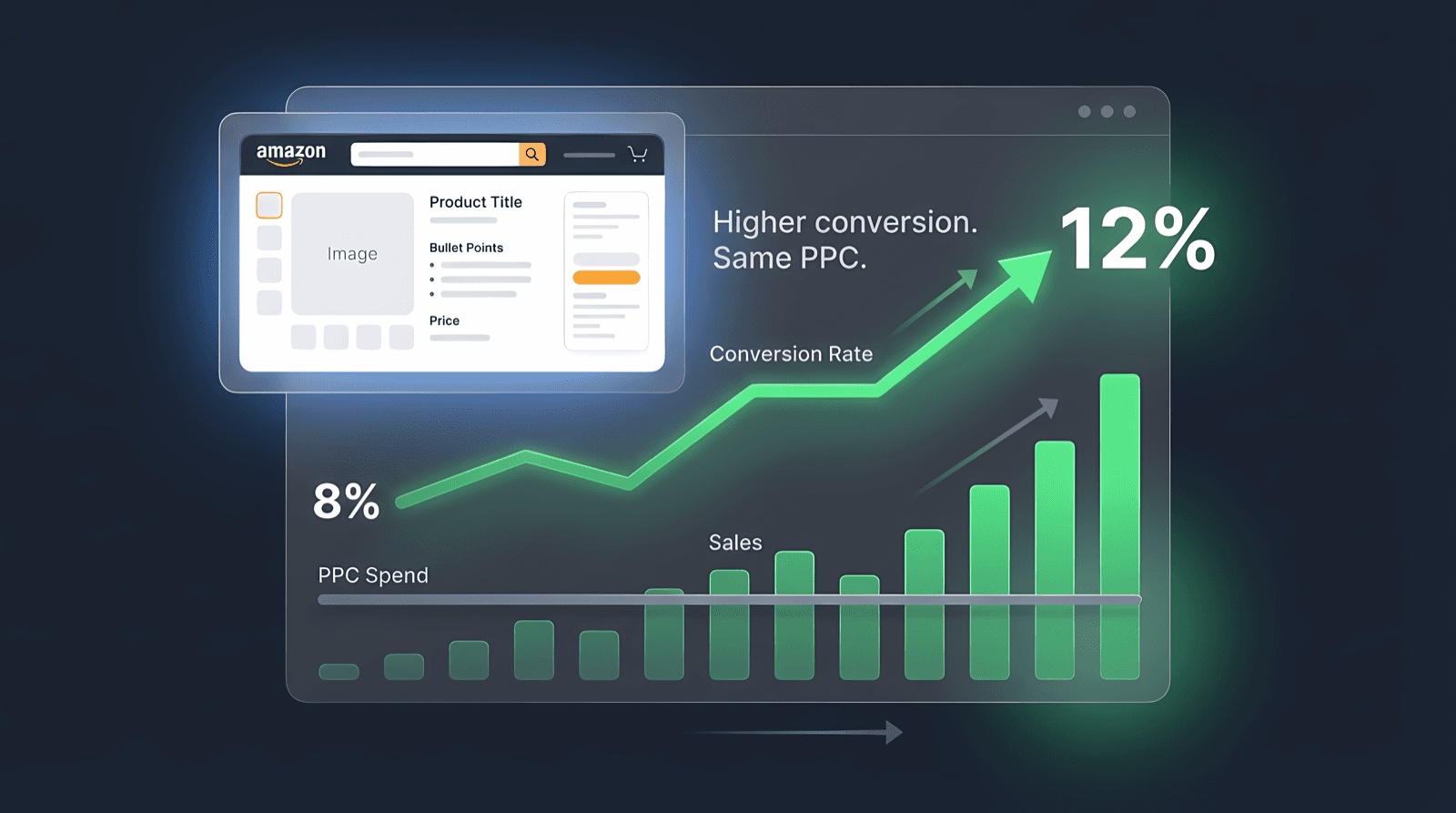
If 100 people visit your product and only 8 buy, the problem isn't a lack of visitors. It's the structure of your listing.
Optimizing your Amazon conversion rate is the most efficient way to:
- Increase sales without raising budget.
- Lower ACOS.
- Improve organic ranking.
- Stabilize advertising performance.
What Is Amazon Conversion Rate (CVR) and How Is It Calculated
Amazon's conversion rate, also known as CVR, measures the percentage of users who purchase after visiting your listing.
Basic formula:
Units ordered ÷ sessions × 100
But on Amazon, CVR isn't just an internal metric. It's a signal that directly influences:
- Organic ranking.
- Product relevance.
- PPC efficiency.
- Likelihood of appearing in featured positions.
Improving CVR on Amazon means improving perceived value and reducing friction in the buying decision.
Why Improving Conversion Rate on Amazon Impacts Organic Ranking
Amazon prioritizes products that sell.
When a listing converts better than the category average:
- It increases relevance for specific keywords.
- It consolidates organic positions.
- It reduces dependence on defensive campaigns.
- It improves stability against competitors.
Optimizing conversion doesn't just increase revenue. It reinforces your visibility.
That's why optimizing your listing must come before scaling Amazon Ads.
What Is a Good Conversion Rate on Amazon
There's no universal number. It depends on the category, price point, and competition level.
As a general benchmark:
- Below 8%: a warning sign. The listing has friction that slows down the buying decision.
- Between 8% and 12%: competitive range for most categories.
- Above 12%: a well-optimized listing with stable positioning.
If your CVR is below your category average, the problem is rarely the price. It's usually the listing architecture.
Main Reasons Your Product Isn't Selling on Amazon
Many sellers search for "how to sell more on Amazon," but the problem usually lies in these structural points.
Lack of Clarity in the Value Proposition
If the user doesn't understand within seconds:
- What the product is.
- Who it's designed for.
- What problem it solves.
Conversion drops.
Amazon listing optimization starts with clarity — not keyword density.
Images That Don't Help Buyers Decide
Images are responsible for:
- Building trust.
- Reducing doubts.
- Justifying price.
- Differentiating from competitors.
A listing with aesthetic but uninformative images silently loses sales.
Optimizing conversion means optimizing visual communication. Every image should answer an implicit buyer question.
Poorly Structured and Unpersuasive Bullets
Many bullets describe technical features but don't address real objections.
An optimized bullet for conversion:
- Explains the benefit.
- Reduces uncertainty.
- Incorporates secondary keywords.
- Improves readability.
Semantic optimization and conversion optimization must work together, not separately.
Negative Reviews Without Strategic Management
Reviews directly influence perceived risk.
If a recurring complaint isn't addressed in the listing, the impact on CVR can be significant.
Reducing perceived risk is increasing conversion. And reducing risk starts by anticipating the objection before the buyer finds it in the reviews.
Price Without Value Context
Price isn't evaluated in isolation.
It's compared against:
- Visual quality.
- Brand positioning.
- Quantity and quality of reviews.
- Differentiation from competitors.
Optimizing conversion also means understanding perceived value on Amazon. Sometimes the price isn't too high — the listing just doesn't justify it.
How to Optimize Your Amazon Listing to Increase CVR
Before raising your advertising budget, review:
- Does your main image stand out on the search results page?
- Does your title match the search intent?
- Do your secondary images explain use and benefits?
- Do your bullets address frequent objections?
- Is your price backed by perceived value?
- Are you measuring conversion by keyword or only at the global level?
Optimizing conversion on Amazon is a structural process, not a surface-level adjustment.
Practical Example: How to Increase Sales Without Raising PPC
Let's say:
- 10,000 sessions
- 9% conversion rate
- 900 sales
If you optimize the listing and bring CVR to 12%:
- 10,000 sessions
- 1,200 sales
- 300 additional sales without increasing traffic.
And additionally:
- Amazon Ads performance improves.
- Real ACOS decreases.
- Organic ranking strengthens.
- Structural TACOS improves.
Conversion optimization multiplies the impact of existing traffic.
Conclusion: Optimize Conversion First, Then Scale Traffic
On Amazon FBA, traffic amplifies what already exists.
If your product doesn't convert, scaling PPC only amplifies inefficiency.
Improving your Amazon conversion rate is the foundation for:
- Profitable growth.
- Organic stability.
- Lower advertising dependency.
- Greater capital efficiency.
Structure first. Then scale.
Strategic Conversion Audit – Finnex Agency
At Finnex, we analyze Amazon conversion optimization as a complete system.
We audit:
- Search intent alignment.
- Traffic distribution by keyword.
- Listing friction points.
- Perceived risk.
- Price elasticity.
- CTR–CVR–ACOS relationship.
If your product has traffic but isn't scaling, the problem is usually structural.
You can request a strategic audit and pinpoint exactly where your conversion is leaking.
Keep reading

Amazon Bullet Points: Structure to Sell More and Better SEO
Learn how to structure Amazon bullet points to convert better, reinforce SEO relevance, and support a stronger listing strategy.
Read more →
How to Optimize Amazon Images to Increase Sales
Complete guide to creating images that increase conversion in your Amazon listings: visual structure, storytelling, and common mistakes to avoid.
Read more →
7 Amazon Listing Mistakes Killing Your Conversion Rate
7 common Amazon listing mistakes that lower your conversion rate, with concrete fixes for main image, title, bullets and A+ Content.
Read more →