7 Amazon Listing Mistakes Killing Your Conversion Rate

By the Finnex Agency team
TL;DR
- If your product has traffic but isn't selling, the problem is almost never traffic — it's the listing.
- The 7 most common errors are visual friction: weak main image, benefit-free title, spec-sheet bullets, missing A+ and no social proof.
- Fixing them requires no extra budget, just method: structure so the buying decision is easy.
Many sellers believe they need more traffic.
But if your product is getting visits and not selling, the problem isn't the traffic.
It's the listing.
If you want to improve your Amazon conversion rate, you first need to eliminate the friction, doubt, and distrust built into your listing.
Optimizing isn't decorating. Optimizing is structuring so that the buying decision becomes easy.
Here are the mistakes that hurt conversion the most — and how to fix them correctly.
What a Low Amazon Conversion Rate Actually Means
The conversion rate (CVR) is the percentage of visitors who end up buying.
In most categories, a healthy range is usually between 8% and 15%, though it varies by niche and price point.
A 1% improvement in conversion can represent thousands of euros in additional monthly revenue without increasing your PPC budget.
That's why improving your Amazon conversion rate is not a technical detail. It's a direct lever for profitability.
1. Poorly Optimized Main Image
If your image isn't understood within 1 second… people don't click. And without clicks, there are no sales.
Common mistakes:
- Product too small within the frame.
- Low contrast.
- Flat lighting.
- Low resolution.
- Looks the same as every competitor.
Correct standards:
- Minimum 1600×1600 px (2000 px or more recommended).
- Pure white background RGB 255 255 255.
- Product occupying at least 85% of the frame.
- Sharp image, no pixelation.
- No text or prohibited elements.
The main image directly impacts CTR. CTR impacts ranking. Without clicks, the algorithm won't favor you.
2. Over-Optimized, Hard-to-Read Title
If your title looks like it was written by a robot… the customer won't trust it.
Serious mistakes:
- Keyword stuffing.
- Unnecessary repetition.
- Excessive use of symbols.
- Phrases with no natural flow.
Ideal length:
- 150–180 characters tends to perform well.
- The first 70–80 characters are critical on mobile.
Recommended structure:
Main keyword → Product type → Key benefit → Differentiator → Size / Material / Quantity
Amazon understands semantics. You don't need to repeat the same word four times.
A clear title improves CTR, time on page, and conversion.
3. Bullets Without Strategic Structure
Don't sell what the product is. Sell what it does for the customer.
Common mistakes:
- Only technical specs.
- No logical order.
- Don't address objections.
- No visible benefit.
Recommended format:
- 5 bullets.
- Approx. 180–250 characters each.
- Benefit first, feature second, real use case or proof at the end.
Each bullet should answer: What problem does it solve? Why is it better? Is it durable? Is it easy to use? What's included?
No excessive emojis. No filler.
4. You Don't Explain Why You're Different
If you don't say why you're better… you compete on price alone.
Many listings describe the product but don't communicate competitive advantage.
You need to clearly answer: Why you and not the next result?
Superior materials, higher quantity, included accessories, better design, real warranty.
Without visible differentiation, the customer compares only price.
5. Image Sequence Without Strategy
Uploading images without order is a common mistake. An effective image sequence follows this logic:
- Clear main image.
- Key benefit.
- Real use.
- Technical detail or proof.
- What's included.
- Comparison or guarantee.
The customer should understand the product without reading too much. If they have to figure it out, you've already lost clarity.
6. Poorly Managed Reviews
This is where many listings lose conversion.
Critical mistakes:
- Too few reviews at launch.
- Not using Vine when possible.
- Not responding to negative reviews.
- Not fixing detected objections in the listing.
A single negative review with low volume can affect weeks of conversion.
Reviews are social proof. Social proof is trust. Trust is conversion.
7. Decorative A+ Content Instead of Strategic
Pretty design that repeats the same information won't improve conversion.
A+ Content should:
- Resolve objections.
- Compare models.
- Explain differences.
- Reinforce benefits.
- Elevate brand perception.
It's not a brochure. It's a closing tool.
Technical Mistakes That Hurt Conversion (Almost Nobody Audits These)
- Repeated words in backend keywords.
- Not using the full 250 bytes.
- Underused synonyms.
- Poorly configured variations.
- Incomplete attributes.
- Not optimizing for mobile.
- Not using Experiments (A/B testing).
Many sellers try to improve their Amazon conversion rate without reviewing these structural details.
Finnex Framework for Improving Amazon Conversion Rate
Conversion = Clarity × Trust × Differentiation
If any one fails, the sale doesn't happen.
- Clarity → Image, title, structure.
- Trust → Reviews, social proof.
- Differentiation → Visible advantage.
Optimizing means working all three pillars.
Conclusion
If your conversion is low, you don't always need more traffic. You need fewer mistakes.
A high-converting listing isn't the prettiest one. It's the one that:
- Removes doubt.
- Builds trust.
- Explains quickly.
- Differentiates clearly.
- Converts without friction.
Improving your Amazon conversion rate isn't about luck. It's about structure.
Not sure which of these mistakes is affecting your case?
Identifying structural flaws in a listing isn't always obvious from the inside.
In our strategic audit we analyze:
- Main image and CTR.
- Title clarity.
- Bullet structure.
- Visible differentiation.
- Social proof.
- Invisible technical elements.
And we show you exactly where conversion is being lost.
Keep reading

Amazon Bullet Points: Structure to Sell More and Better SEO
Learn how to structure Amazon bullet points to convert better, reinforce SEO relevance, and support a stronger listing strategy.
Read more →
How to Optimize Amazon Images to Increase Sales
Complete guide to creating images that increase conversion in your Amazon listings: visual structure, storytelling, and common mistakes to avoid.
Read more →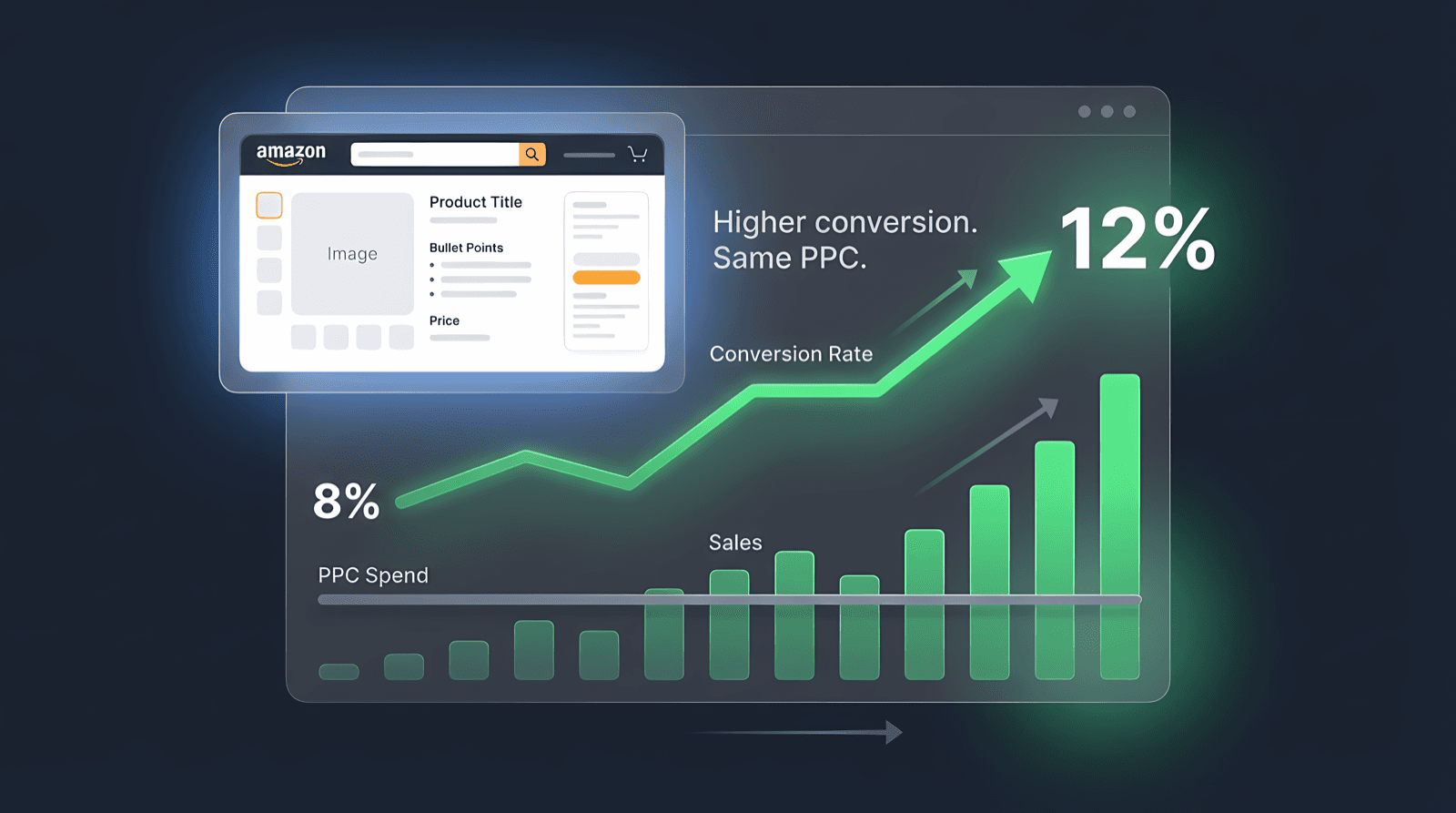
Improve Amazon Conversion Without Raising Your PPC Budget
Learn how to optimize your Amazon conversion rate (CVR) without raising ad spend: images, bullets, reviews, and perceived value to sell more efficiently.
Read more →