How to Tell if Your Amazon PPC Is Poorly Structured

By the Finnex Agency team
TL;DR
- An account with sales can still be poorly structured: if your ACOS swings without explanation or campaigns won't scale, there's an invisible problem.
- The 8 most common signals are unstable ACOS, autos and manuals stepping on the same traffic, no keyword harvesting, and budget running out on the wrong campaigns.
- Scaling spend without fixing structure first amplifies the errors instead of the sales.
An Amazon Ads account can be active, with campaigns running and even generating sales, and still be completely poorly structured.
The problem is that bad structure doesn't always show itself immediately. Sometimes it manifests silently: an ACOS that rises for no apparent reason, campaigns that won't scale even when you raise the budget, or keywords that perform well but are buried next to others that are losing money.
This article shows you the concrete signals to detect whether your account has a structural problem — and what each of them means.
Before we start: terms you'll see in this article
If you're just getting into Amazon Ads, these are the key concepts you'll need to follow along.
- ACOS (Advertising Cost of Sales). The percentage of your sales you spent on advertising. If you spent $20 on ads and sold $100, your ACOS is 20%. The lower it is, the more efficient your advertising.
- Search Term Report (STR). An Amazon report that shows you exactly what shoppers typed before clicking your ad. It's the single most valuable tool for knowing whether your advertising is attracting the right traffic.
- Automatic vs. manual campaigns. Automatic campaigns let Amazon decide where to place your ad. Manual ones you control: you pick exactly which keywords to bid on. Both have a role, but they have to work together with a clear logic.
- Keywords. The words or phrases you bid on so your ad appears (for example: "sports water bottle" or "stainless steel tumbler").
- Negative keywords. Words or phrases you tell Amazon you do NOT want your ad to show on. If you sell premium backpacks, you can add "cheap" as a negative to avoid clicks from users who won't buy anyway.
01. Why structure matters more than budget
The reason many accounts don't grow even when they invest more.
A lot of people believe that when results aren't good, the answer is to raise the budget. But budget only works when the structure is solid.
Think of it like a house. You can have the best furniture and the most expensive decor, but if the foundation is broken, everything wobbles. Your Amazon Ads account works the same way: structure defines whether the data you see is trustworthy, whether you can make the right decisions, and whether the budget is being allocated well.
When the structure is broken, three things happen at the same time:
- The data gets mixed and you can't tell what's working and what isn't.
- Bidding and budgeting decisions get made on top of numbers that don't represent reality.
- When you raise the budget, instead of scaling sales, you scale the errors.
The active-account paradox
An account can be spending thousands of dollars a month, have steady sales and a seemingly controlled ACOS — and still be completely unoptimizable.
That happens when the data inside the account is contaminated by bad structure. Without clean data, every decision you make is partly a guess.
The good news: bad structure leaves clear signals. And those signals show up before the problem becomes impossible to reverse.
Disorganized vs. organized structure
| Disorganized structure | Organized structure |
|---|---|
| Everything mixed in a handful of campaigns | One campaign per search intent |
| An average ACOS that represents nothing | A readable ACOS by traffic type |
| Automatics and manuals competing with each other | Automatics explore, manuals convert |
| Budget spread randomly | Budget allocated to what performs |
| Impossible to tell which keyword drives sales | Continuous harvesting from the Search Term Report |
02. The 8 signals that your PPC is poorly structured
How to spot the problem before it gets expensive.
You don't need a full audit to detect that something's off. These are the most common signals in accounts with structural problems. If you recognize two or more, there's likely concrete work to be done.
Signal 1: Your ACOS rises and falls with no clear reason
An ACOS that swings widely week to week, without anything visible to explain it (a price change, a peak season, a competitor move), usually means the data inside the account is mixed.
When a single campaign contains branded searches, generic terms, competitor keywords and discovery terms all together, the ACOS you see is an average of very different things. That average doesn't allow you to make any useful decision.
The contaminated-ACOS problem
| Traffic type | Real ACOS | Correct decision |
|---|---|---|
| Own brand | 6% | Scale aggressively |
| Converting generics | 22% | Tune bids |
| Discovery / Broad | 65% | Negativize and review |
| Average you see in the mixed campaign | 28% | No decision is correct |
The number you see doesn't represent either type of campaign. It's a blend that hides both what's working and what isn't.
Red flag: if you can't confidently answer "what's my brand campaign ACOS?" and "what's my generic terms ACOS?" separately, your campaigns are mixed.
Signal 2: Your automatic and manual campaigns target the same searches
Automatic and manual campaigns serve different functions. Automatic exists to explore and discover opportunities. Manual exists to convert with control and precision. If there's no clear separation between them, they end up competing with each other.
When both target the same traffic with no negatives to separate them, you're paying twice for the same click. On top of that, your automatic's data gets contaminated and stops being useful for learning which terms deserve to graduate to manual.
Concrete example: you have an automatic campaign and a manual campaign with the keyword "1L steel tumbler". If you don't block that term as a negative in the automatic, both campaigns compete in the same Amazon auction for that same shopper. Amazon can show either one, and you're overpaying without knowing it.
Red flag: if your automatic campaigns don't have negatives matching the keywords you already have in manual campaigns, there's active overlap right now.
Signal 3: You've got too many products mixed in too few campaigns
A well-structured campaign should let you make precise decisions. That means when you raise or lower a bid, you know exactly which product or group of products you're affecting.
When you have 15 different products (with different prices, margins and categories) in a single campaign, any change you make affects them all equally. If you raised the bid so product A gets more visibility, you also raised it for product B — which didn't need more spend.
Concrete example: you have a hero product at 40% margin and a complementary one at 15% margin in the same campaign. If you need to bid high for the hero product, the low-margin product ends up with an unsustainable ACOS. You can't solve this without splitting them into different campaigns.
Red flag: if you have more than 5 products in a single ad group with no clear strategic reason, the data and the bids are mixed in a way that prevents optimization.
Signal 4: You don't separate match types into different campaigns
Amazon Ads' three match types serve very different functions. If they all live together in the same ad group, you can't see real per-type performance or adjust bids differently for each.
Match types and their function
| Match type | How it works | Strategic function |
|---|---|---|
| Broad | Amazon shows your ad on wide variations of the term | Explore and discover new keywords |
| Phrase | Amazon respects word order but allows close variants | Capture long-tail variations of the core keyword |
| Exact | Only shows when the search matches almost exactly | Convert with maximum cost control |
When Broad, Phrase and Exact coexist in the same ad group, the algorithm prioritizes the broadest type to get impressions. That means your Broad Match may be eating most of the budget while you think it's your Exact Match keywords doing the work.
Red flag: if you have Broad Match and Exact Match for the same term in the same ad group, the data is unreadable and you can't make correct bidding decisions.
Signal 5: You don't review the Search Term Report regularly
The Search Term Report (STR) shows you exactly what the shopper searched for before clicking your ad. It's the most valuable source of information you have for knowing whether your advertising is attracting the right traffic or the wrong one.
A well-managed account reviews this report at least every 7 to 14 days. The review has two clear goals:
- Find terms that convert well so you can move them into manual campaigns on Exact Match (this is called keyword harvesting).
- Detect terms that consume budget without producing sales, and block them with negatives.
The keyword harvesting cycle
- The automatic campaign generates exploratory traffic.
- You review the Search Term Report every 7–14 days.
- You find terms that converted with a good ACOS.
- You add them in Exact Match to a manual campaign.
- You block that term in the automatic with a negative.
- The cycle repeats every 1 to 2 weeks.
This cycle repeats regularly. Over time, manual campaigns become more precise and the spend becomes more efficient.
Without this process, the account doesn't learn. Spend accumulates on irrelevant terms week after week, and the advertising gets worse over time instead of better.
Red flag: if you don't know when you last reviewed the Search Term Report, there is unnecessary spend accumulating in your account right now.
Signal 6: Your branded campaigns are mixed with the generic ones
When someone searches your exact brand name on Amazon, they already know what they want. That user has much higher purchase intent than someone searching a generic term like "steel tumbler". That's why branded campaigns typically run 2 to 4 times lower ACOS than generic ones.
The problem appears when both live in the same campaign. The strong performance of the branded keywords pulls the campaign's average ACOS down, and that hides the poor performance of the generic keywords. You end up making decisions on a number that represents neither type of traffic.
Concrete example:
- Brand keywords: 7% ACOS
- Generic keywords: 55% ACOS
- Average ACOS for the mixed campaign: 28%
You see 28% and assume everything's under control. But in reality, half of your generic spend is losing money — and you can't see it because the brand numbers are masking it.
Red flag: if you don't have a dedicated campaign for brand terms, your account data is distorted and the real performance of each traffic type is invisible.
Signal 7: Budget runs out before end of day in the wrong campaigns
Many sellers notice that their campaigns hit budget cap mid-morning or by lunchtime, but they miss the real problem: budget is running out on the least efficient campaigns, while the best ones run out of funds during peak demand.
On Amazon, peak purchase-intent hours vary by category and country, but they often line up with late afternoon and evening. If your best campaigns went dark at lunchtime, those key hours were lost.
How to read budget problems
| What you see | Likely diagnosis | Immediate action |
|---|---|---|
| High-ACOS campaigns consume budget first | Inverted distribution: money goes where it performs worst | Cut budget on those, reallocate to converters |
| Best campaigns run dry at midday | You're losing peak-afternoon hours | Raise budget and review dayparting |
| All campaigns have the same budget | No prioritization by performance | Reallocate by ROAS and real margin |
| Daily budgets never get used | Bids too low or targeting too narrow | Review bid competitiveness and keyword expansion |
Red flag: if the highest-ACOS campaigns end the day with budget leftover and the best-converting ones run out first, your budget distribution is upside down.
Signal 8: You don't have a keyword harvesting system
Keyword harvesting is the process by which an account improves over time. It consists of identifying, inside the Search Term Report, terms that converted well in automatic or Broad Match campaigns and moving them into manual campaigns on Exact Match. That way, instead of relying on Amazon to decide where to show your ad, you control exactly what gets paid for that proven-winning term.
Without this process, the account becomes static. Automatics keep spending on the same terms without improving, manuals don't incorporate new learning, and traffic quality doesn't grow even as spend goes up.
Red flag: if your manual campaigns have exactly the same keywords as six months ago, the account is stuck and isn't learning from real data.
03. The 5-minute test
How to run a quick diagnosis of your account without being an expert.
You can make a first assessment of your account's structure by answering five simple questions. You don't need access to complex reports. Just by looking at your Amazon Ads account, you can answer Yes or No.
Quick diagnostic test (answer Yes or No):
- Do you have a dedicated, separate campaign for brand terms?
- Do your automatic campaigns have negatives matching the keywords you've already promoted to manuals?
- Does each ad group have a single match type (Broad, Phrase or Exact)?
- Have you reviewed the Search Term Report in the last two weeks?
- Can you confidently name your best keyword from the past month?
How to read your result:
- 0 or 1 No: the structure has a reasonable foundation. There may be room for improvement, but there's no critical problem.
- 2 or 3 Nos: there are real structural problems. Before raising the budget, it's worth reorganizing so the money works better.
- 4 or 5 Nos: the structure is broken. Every dollar you invest in advertising is working with far less efficiency than it could.
04. What happens when you scale a poorly structured account
Why the problem becomes more expensive and harder to fix over time.
The natural reaction when an account isn't delivering is to raise the budget. It seems logical: more investment should bring more sales. But that logic only works when the foundation is well built.
When the structure is broken, raising the budget amplifies the existing errors. It's like adding more fuel to an engine with a design flaw: the engine spins faster, but it's still broken — and the faster it spins, the more damage it does.
There's also a hidden effect many sellers don't see until it's too late: the impact on organic sales. On Amazon, organic ranking depends in part on conversion volume. If your poorly structured campaigns aren't sustaining that volume consistently, organic positioning starts dropping. And recovering it costs much more than keeping it would have.
The downward spiral of scaling without structure:
- The account underperforms, so you raise the budget.
- That extra budget pours into your existing, poorly structured campaigns.
- Spend grows on terms that don't convert; ACOS climbs.
- Since ACOS is climbing, you start cutting campaigns to "stop the bleeding".
- Some of those cuts hit campaigns that were actually working — because the mixed data made them indistinguishable.
- Total sales drop, conversion falls and organic rank begins to slide.
- To offset the organic drop, you raise the budget again. The cycle repeats.
The solution isn't to spend more. It's to organize the structure first.
The conclusion we see in every audit: most sellers who come to us after months of high ACOS and stagnant sales don't have a budget problem. They have a structure problem. And the budget they raised without fixing the account first only accelerated the issue.
05. What a minimum organized structure should look like
The 6 pillars of an account that can be optimized and grown.
There's no single perfect structure that fits every business. But there is a set of basic principles without which no account can be managed with judgment. These are the 6 fundamental pillars.
The 6 pillars and the consequences of skipping them
| Pillar | What it guarantees | Consequence of not having it |
|---|---|---|
| 1. Separate brand campaign | Isolates the highest-intent traffic and protects a clean ACOS | Strong brand performance hides the real performance of generic keywords |
| 2. Match types separated by campaign | Readable performance by match type and correct bids | Broad eats the budget you thought was going to Exact |
| 3. Automatics with negatives pointing at manuals | Automatics explore without stepping on what already converts in manuals | You pay twice for the same click and automatic data gets polluted |
| 4. Few products per ad group | Precise bids that hit the correct product | A single bid affects products with different margins and prices |
| 5. Regular Search Term Report reviews | The account learns and improves over time | Spend accumulates on irrelevant terms; no new learning enters the account |
| 6. Systematic keyword harvesting | Manuals receive terms validated by real shopper behavior | Campaigns stay static and traffic quality never grows |
Each of these pillars prevents a specific type of problem. When all six are in place, the account becomes legible: you can see exactly what's working, where the inefficient spend is, and what to move first to improve results.
To wrap up
Bad structure isn't just an organizational problem. It's a problem of visibility, of efficiency and — over time — of real business growth.
A poorly structured account can't be diagnosed well because the data is mixed. It can't be optimized because decisions are made on averages that don't represent anything. And it can't scale because more budget amplifies the inefficient spend rather than the sales.
Three takeaways from this article:
- Structure defines how useful your data is. Without clean data, optimization is impossible.
- The most common signs of bad structure are unstable ACOS, campaign overlap, and lack of Search Term Report reviews.
- Scaling budget without first organizing the structure doesn't solve the problem — it makes it bigger.
If reading this article you recognized two or more of these signals in your account, there are likely concrete improvement opportunities that aren't easy to see from the inside. At Finnex we run audits that analyze the real structure of your campaigns, detect where the inefficient spend is hiding and define what to reorganize first so the budget starts working with better judgment.
→ Request your free audit and get a clear diagnosis of your account within 48 hours.
Keep reading
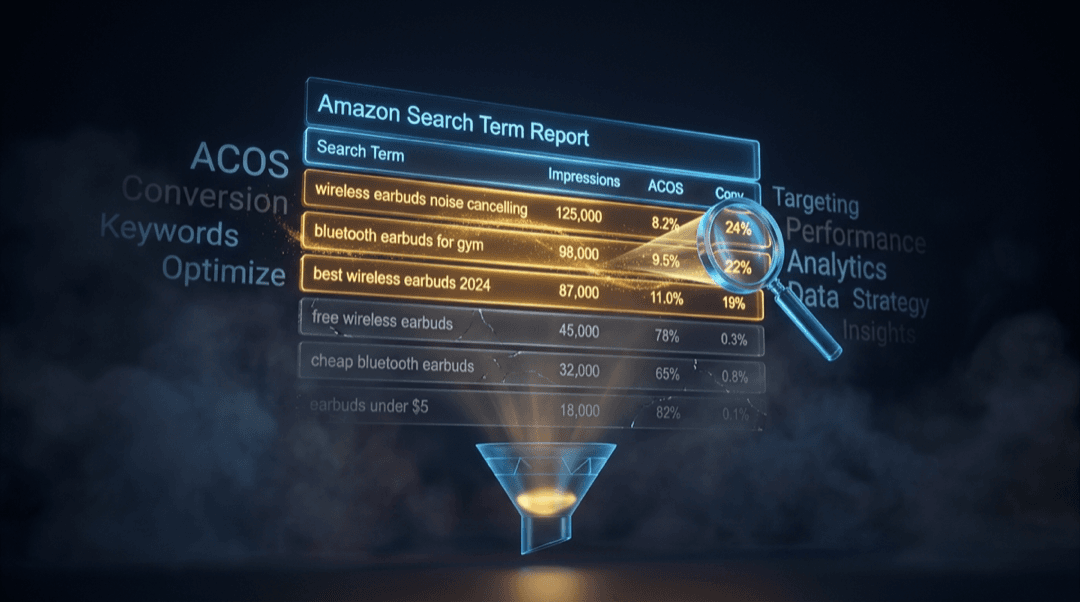
How to Analyze the Search Term Report Correctly
The Search Term Report shows what shoppers actually searched. Learn to read it with the 4-quadrant framework and optimize your Amazon PPC.
Read more →
Amazon Ads Scaling Strategy: From Campaigns to Growth
How to move from active campaigns to a real Amazon Ads scaling system: structure, the PPC-organic flywheel, inventory, and TACoS.
Read more →
Defend Your Brand on Amazon Ads Without Inflating Spend
Defending your brand on Amazon isn't about spend — it's about structure. Protect branded searches and stop competitors from capturing your traffic.
Read more →