Amazon Ads Scaling Strategy: From Campaigns to Growth
By the Finnex Agency team
TL;DR
- Scaling on Amazon Ads in 2026 isn't about raising the budget. It's about building a system where PPC drives sales that improve organic ranking, which in turn reduces your dependence on PPC.
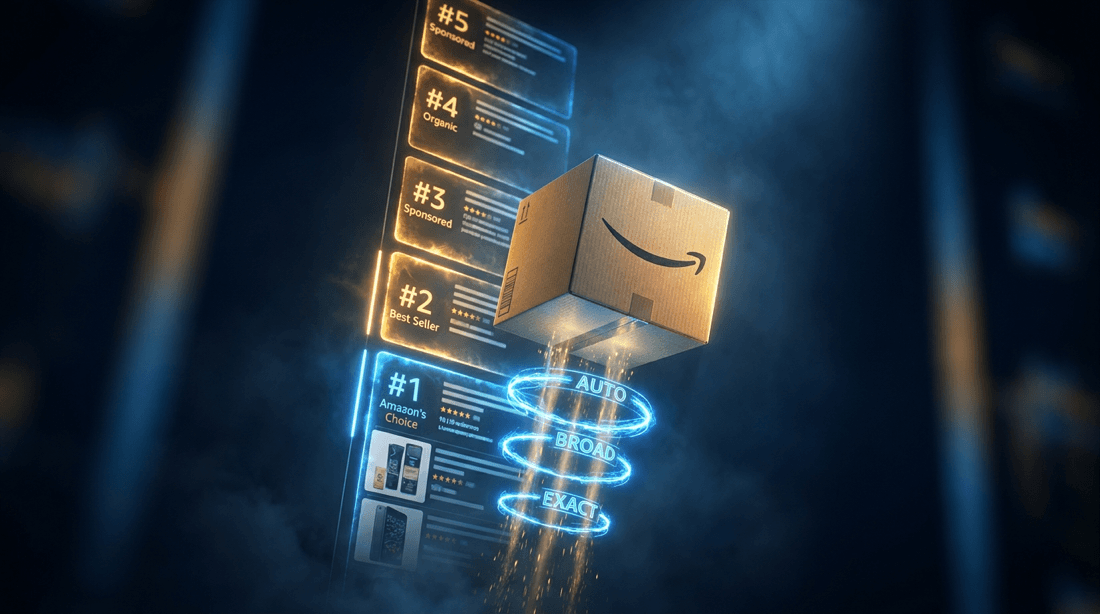
- The right structure follows a logical flow: auto campaigns as radar → manual broad as amplifier → manual exact split into dominance and stability.
- Organic sales carry more weight in the algorithm than paid sales. PPC's job is to force that organic positioning, not replace it.
- Without enough inventory, scaling is impossible. Amazon directly penalizes anyone with less than 28 days of historical inventory.
- A TACoS that drops while revenue grows is the clearest sign the system is working well.
Before we start: terms you'll see in this article
TACoS (Total Advertising Cost of Sales). The percentage of your total sales (organic + paid) that you spent on advertising. It's the metric that best reflects the real health of the business. If TACoS drops while sales grow, the system is gaining efficiency.
ACoS (Advertising Cost of Sales). The percentage of your paid sales that the ads cost. Useful for measuring campaigns, but not enough to measure the business.
Organic ranking. The position your product holds in Amazon's search results without advertising. The higher it is, the more sales you get at no advertising cost.
PPC-organic flywheel. The virtuous cycle where PPC-driven sales improve organic ranking, which generates more organic sales, which lowers TACoS over time.
ASIN. The unique code Amazon assigns to each product. When you run product targeting campaigns, you target specific ASINs.
Match type. How exact the shopper's search has to be for your ad to appear. Broad, Phrase, and Exact behave very differently.
FNSKU. Amazon's internal code for each variant of your product. Starting in 2026, the low-inventory fee is calculated at the FNSKU level, not the parent ASIN.
01. The mistake most people make when they want to scale
When results fall short of expectations, the most common response is to increase the budget. It seems logical: more investment should bring more sales. But that logic only works when there's a well-built foundation behind it.
Scaling without structure doesn't create growth. It creates more spend on the same problems you already had.
The other common mistake is believing that scaling on Amazon Ads is synonymous with buying visibility. In 2026, that's no longer enough. Amazon doesn't simply prioritize whoever pays the most. It prioritizes whoever converts better, has better reviews, maintains steady inventory, and generates sales the algorithm can interpret as a signal of real relevance.
That's the difference between an account that scales and one that just spends: one speaks well to the algorithm, the other only pays it.
What scaling really means:
| What most people do | What scaling actually is |
|---|---|
| Raise the budget on existing campaigns | Improve the structure before adding investment |
| Measure success by gross sales | Measure success by TACoS and contribution margin |
| Depend on PPC to sustain sales | Use PPC to force organic positioning |
| Scale when campaigns "are doing fine" | Scale when there are clear signals and clean data |
02. The principle that changes everything: the PPC-organic flywheel
On Amazon, organic sales carry more weight for the algorithm than paid sales. That completely changes how advertising has to be thought about.
PPC isn't the destination. It's the vehicle to reach organic positioning.
When a product generates sustained sales through well-structured campaigns, the algorithm interprets that product as relevant for those searches. That relevance translates into better organic positioning. And that organic positioning generates sales at no advertising cost, which brings TACoS down even as total sales keep growing.
That's the flywheel: PPC → sales → organic ranking → more organic sales → lower TACoS → more budget available to keep scaling.
The flywheel cycle in practice:
- Well-structured campaigns generate conversions on strategic keywords.
- Amazon interprets those conversions as a relevance signal.
- The product climbs positions in the organic results.
- Organic sales increase at no additional cost.
- TACoS drops even though the budget stays the same.
- The freed-up budget is reinvested in new keywords or in scaling the ones already working.
- The cycle repeats.
A TACoS that drops while revenue grows is the clearest sign the flywheel is working. If TACoS rises while sales stall, PPC is replacing demand instead of creating it.
03. The campaign structure for scaling: the 2026 funnel
There's no scaling strategy without a campaign structure to support it. An account where everything is mixed together can't be optimized, and an account that can't be optimized can't grow in a controlled way.
The 2026 funnel has four levels with distinct functions. They aren't optional: each one fills a specific role the others can't replace.
Level 1: Auto campaigns — The radar
Auto campaigns are the entry point to the system. Their job isn't to convert efficiently: it's to explore. Amazon chooses where to show your ad based on the listing, the product attributes, and shopper behavior. That generates real data on which terms bring clicks, which convert, and which simply burn budget.
The most common mistake with auto campaigns is letting them run without reviewing them. An auto campaign without periodic review of the Search Term Report will accumulate spend on irrelevant terms indefinitely.
What auto campaigns are for:
- Discovering search terms with real conversion that you wouldn't have chosen manually.
- Detecting unexpected placements where the product performs well.
- Feeding data to the rest of the structure.
Key rule: auto campaigns must have negatives matching the keywords you've already scaled into manual campaigns. Without those negatives, the auto and the manual campaign compete in the same auction, and you're paying twice for the same click.
Level 2: Manual Broad — The amplifier
With the terms that converted in the auto campaign, the next step is to work them in broad match. Broad isn't "throwing terms at random": it's taking words with proven conversion and exploring their long-tail variations with more control than an auto campaign allows.
A keyword that converted in auto can have dozens of variations (long tails) that also convert and have less competition. Manual Broad lets you find them without depending on Amazon to decide on its own.
The difference between auto and manual Broad:
| Auto | Manual Broad | |
|---|---|---|
| Who decides the targeting | Amazon | You, with chosen seeds |
| Bid control | Limited | Full |
| Data source | The algorithm's free traffic | Selected keyword variations |
| Strategic use | Initial discovery | Controlled expansion of validated terms |
Level 3: Manual Exact — The consolidation
This is where most of the real scaling happens. Exact Match campaigns split the work into two fronts with different objectives.
Dominance campaigns: 4 or 5 "queen" keywords —the ones with the highest search volume and proven conversion— with aggressive bids. The goal is to take the top positions for those terms and trigger organic ranking. These campaigns can have a higher-than-average ACoS, and that's fine: they're an investment in positioning, not in immediate profitability.
Stability campaigns: long-tail keywords with moderate bids. Their goal is to sustain a steady volume of sales at a profitable ACoS. They're the cushion of the business while the dominance campaigns do the positioning work.
The logic behind this split is simple: you can't manage a campaign that aims to dominate a competitive keyword and one that aims to maintain profitability with the same criteria. If you mix them, you'll make the wrong decisions for both.
Fixed vs. dynamic bids: for Exact campaigns, we recommend fixed bids instead of Amazon's dynamic strategies. Dynamic bids give the algorithm freedom to adjust how much you pay in each auction, which can be useful in exploration stages but complicates control when you want to scale with intent. With fixed bids, you know exactly how much you're paying for each position.
Summary of the full structure:
| Campaign | Function | Bid | Review |
|---|---|---|---|
| Auto | Term discovery | Dynamic | Every 7-14 days |
| Manual Broad | Long-tail expansion | Fixed or controlled dynamic | Every 14 days |
| Exact dominance | Positioning on queen keywords | Fixed aggressive | Weekly |
| Exact stability | Profitable sales with long tail | Fixed moderate | Biweekly |
04. Offense and defense: the two sides of professional scaling
Once the base structure is working, there are two strategic moves that accelerate scaling: attacking the competition's market share and defending your own.
ASIN attack campaigns
ASIN targeting lets you show your ad directly on a competitor's product detail page. Not in the search results: on the competitor's listing, while the shopper is evaluating whether to buy that product.
If your listing is superior (better images, better reviews, better relative price), you're entering at the moment of highest purchase intent and offering a better alternative. The competitor loses the sale, you win it.
The most interesting ASINs to attack aren't the category leaders (they have too much accumulated authority and bids are sky-high), but the ones sitting between positions 3 and 5 in the ranking. They have relevant traffic but less ability to defend.
Criteria for choosing ASINs to attack:
- Products with reviews similar to or worse than yours.
- Listings with weak images or unclear bullets.
- Similar prices where your value proposition is visible.
- Products in positions 3 to 5 of the ranking for keywords where you want to gain ground.
Defense campaigns
The other side of the coin: if you can show up on the competition's listings, the competition can also show up on yours.
Defense campaigns consist of advertising your own products within your own listings. If someone is looking at your product page, a Sponsored Display campaign or self-ASIN targeting ensures the ads appearing on that page are your brand's, not a competitor's stealing the sale at the last second.
It's a low investment with a direct impact on conversion rate and on protecting the traffic you've already generated with everything above.
05. The listing as a scaling factor (not just PPC)
An Ads scaling strategy can be accelerated or completely stalled depending on the state of the listing. Amazon uses artificial intelligence models (BERT to interpret search intent, Cosmo to understand product context and attributes) that go beyond exact word matching.
That means Amazon can show your product for searches you don't have in the title, if the algorithm understands that you solve the shopper's problem. A beard oil can appear when someone searches for "facial moisturizer for men's dry skin" if the listing communicates well what it's for and who it helps.
The practical implication: a listing written naturally and oriented to the shopper's problem converts better, speaks better to the algorithm, and makes every PPC click pay off more.
What a listing ready to scale needs to have:
| Element | What to look for |
|---|---|
| Title | Main keyword + clear value proposition in the first words |
| Bullet points | Benefit before feature, natural language, answers shopper questions |
| Description / A+ Content | Usage context, application cases, brand storytelling |
| Images | Flawless white-background main image, secondaries showing use, scale, and differentiation |
| Attributes and backend | Complete fields, backend keywords without repeating what's already in the frontend |
| Q&A | Frequently asked questions answered with natural keywords |
An incomplete or poorly optimized listing means every visit PPC brought in fails to convert. And without conversion, there's no signal for the algorithm. Without signal, there's no organic ranking. The cycle never starts.
06. The most underestimated factor: inventory
There's no scaling strategy without enough inventory. It's the element that most frequently limits the growth of an account that's otherwise doing everything right.
When Amazon detects that your historical inventory level is below 28 days of supply, it applies a low-inventory fee charged per unit. Starting in 2026, that fee is calculated at the FNSKU level (that is, per individual variant, not the parent ASIN as a whole), which especially impacts products with multiple variants.
The fees range from $0.32 up to $2.09 per unit depending on the product size and how far below the 28-day threshold you are. It's not a minor number when it adds up across thousands of units.
But beyond the fees, there's a strategic effect that matters more: when your product has steady inventory and scales in sales until it reaches "Best Seller" status or positions itself as the bestseller of its niche, competitors stop bidding aggressively against you. Auction competition drops, cost per click tends to decrease, and PPC becomes more efficient even with the same budget.
Inventory isn't just logistics. It's an active competitive advantage.
How inventory affects scaling:
| Inventory level | Impact on the account |
|---|---|
| Less than 28 historical days | Low-inventory fee active, algorithm reduces visibility |
| 28 to 60 days | No penalty, but no ranking advantage from availability |
| 60+ steady days | Positive reliability signal, better position for algorithm and Buy Box |
| Stock in Amazon Warehousing & Distribution (AWD) | Low-inventory fee waived while AWD handles replenishment |
07. How to know if you're ready to scale
Before increasing investment, there are concrete signals that indicate whether the account is in a position to absorb that growth or whether you need to get it in order first.
An account is ready to scale when:
- It has at least 2 to 4 weeks of stable data with consistent conversions on the main campaigns.
- ACoS is legible by campaign type (not a mixed average).
- Auto campaigns are regularly feeding new terms to the manual ones.
- The listing converts at a healthy rate for the category (you can see this in the Business Report in Seller Central).
- Inventory is guaranteed for at least 60 days ahead.
- You can say with certainty what your best keyword of the last month was and why.
If you can't answer at least four of those six questions with concrete data, scaling the budget first will amplify the problems instead of the results.
08. The metric that defines whether scaling works: TACoS in decline
The clearest indicator that a scaling strategy is working isn't the ACoS of any particular campaign. It's the business's total TACoS in relation to total revenue.
The ideal scenario is this: revenue grows, ad spend grows at a slower pace, and TACoS drops progressively. That means organic sales are increasing as a share of the total, which indicates ranking is improving and PPC is fulfilling its real function.
How to read TACoS at different moments of scaling:
| Moment | Expected TACoS | What it means |
|---|---|---|
| Launch or relaunch | 30-50% or more | Normal: you're buying data and positioning |
| Active growth phase | 15-25% | The flywheel starts to work |
| Maturity and dominance | 8-15% | Organic sales already sustain the business |
| Alert reference | TACoS rises while sales stall | PPC is replacing demand, not creating it |
These ranges vary significantly by category, product margin, and level of competition. They aren't universal numbers: they're references for understanding the direction of the business, not for applying mechanically.
To wrap up
Scaling on Amazon Ads isn't a budget decision. It's a decision about structure, data, and understanding the system.
The path is concrete: a solid listing that converts, a campaign structure that generates clean data, PPC that forces organic positioning, inventory that sustains growth, and a TACoS that drops while revenue rises. Each piece depends on the ones before it.
When all those elements work together, scaling stops being a cost you have to justify and becomes a system that works in the business's favor in a compounding way.
Three ideas to take away from this article:
- PPC is the vehicle, not the destination. Its job is to build the organic ranking that later sells without you paying for every click.
- The right structure precedes the budget. Scaling on top of a messy structure amplifies the mistakes, not the sales.
- A declining TACoS with rising revenue is the clearest sign the system is working.
If, reading this article, you recognize that your account has active campaigns but no real scaling strategy, at Finnex we run audits that analyze your current structure, identify where the inefficient spend is, and define what to reorganize first so that PPC starts building real positioning. You can request your free audit and get a clear diagnosis of your account within 48 hours.
Keep reading
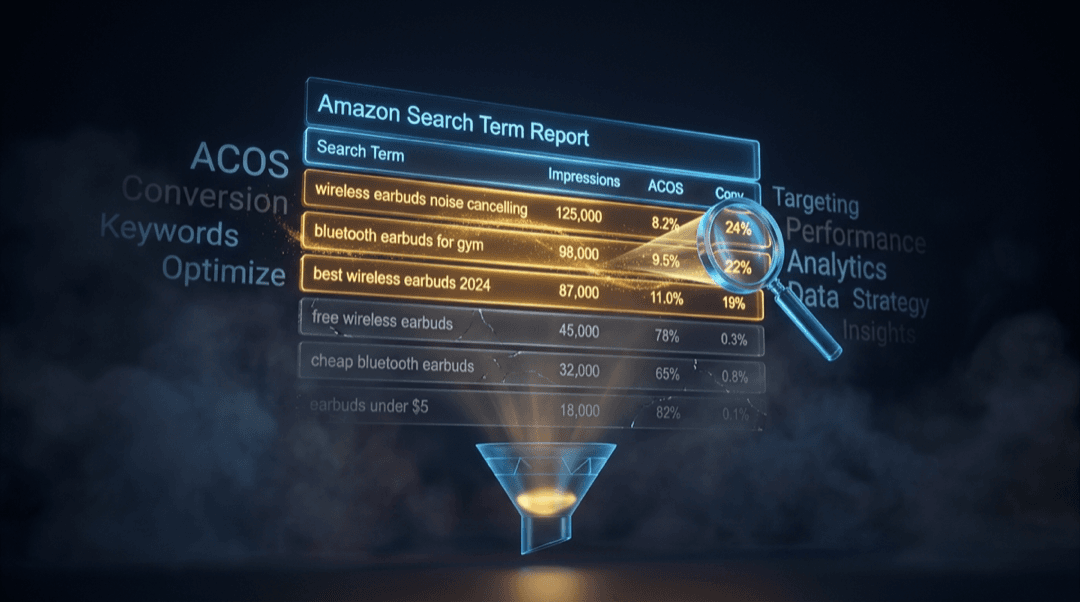
How to Analyze the Search Term Report Correctly
The Search Term Report shows what shoppers actually searched. Learn to read it with the 4-quadrant framework and optimize your Amazon PPC.
Read more →
How to Tell if Your Amazon PPC Is Poorly Structured
Your account can be running campaigns and still be poorly structured. 8 signals that something is broken in your Amazon Ads before scaling spend.
Read more →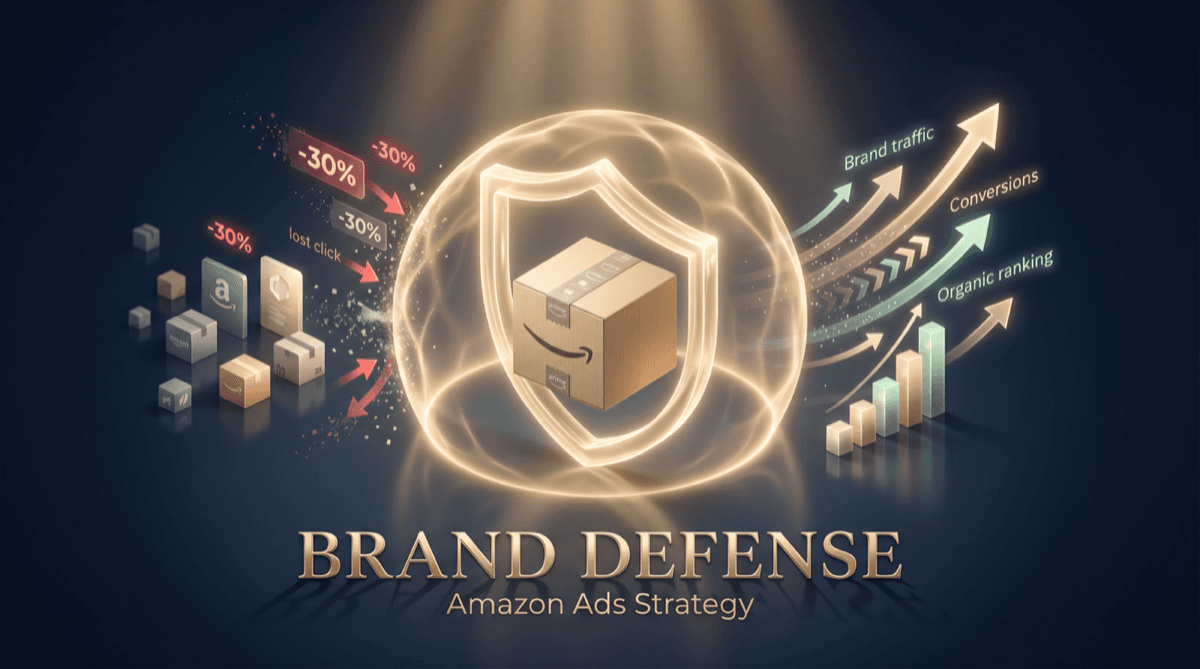
Defend Your Brand on Amazon Ads Without Inflating Spend
Defending your brand on Amazon isn't about spend — it's about structure. Protect branded searches and stop competitors from capturing your traffic.
Read more →