AI Review Summaries on Amazon: How They Affect Your Conversion
By the Finnex Agency team
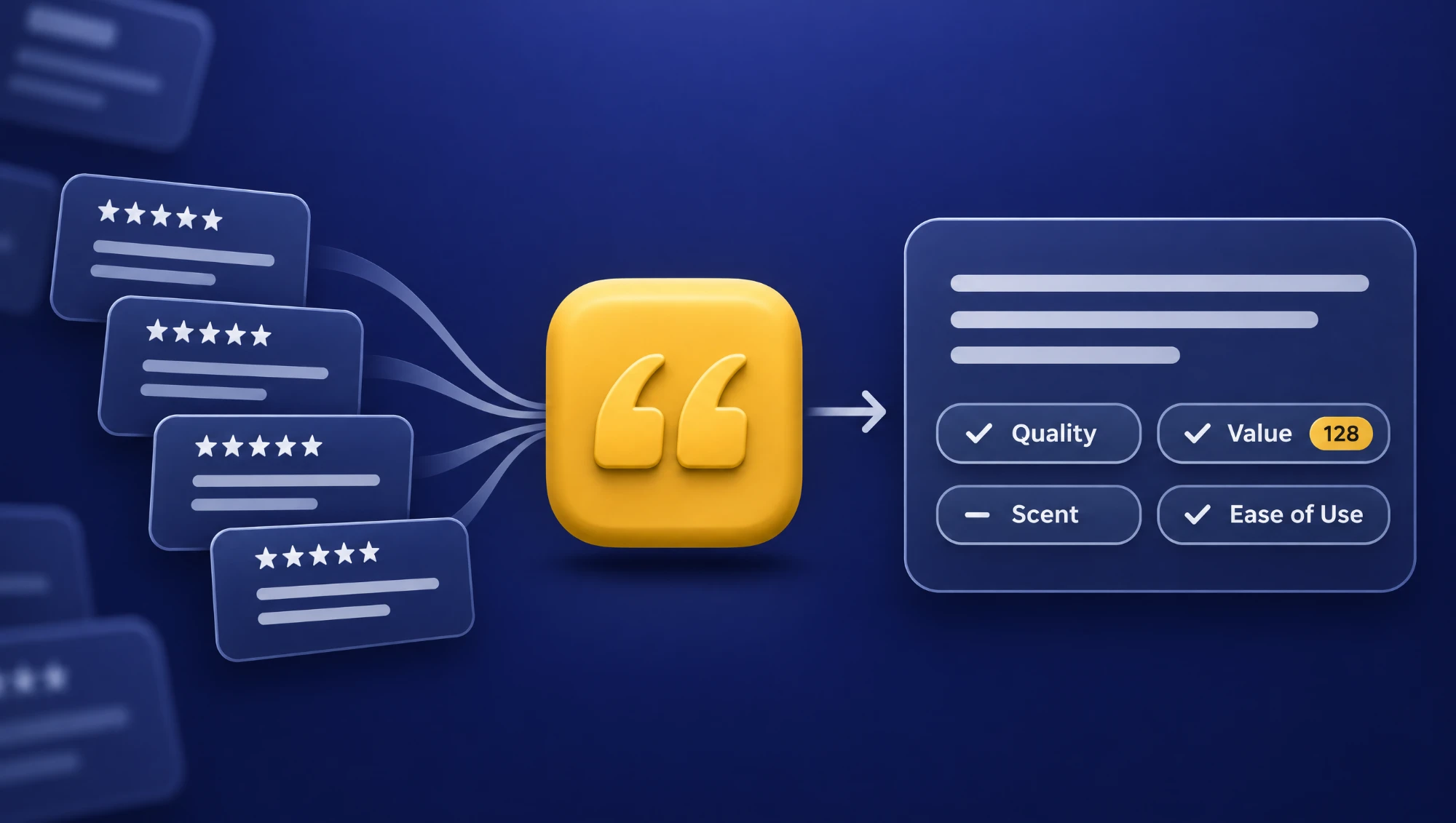
Short answer. On every product page with enough reviews, Amazon shows an AI-written paragraph under the heading "Customers say" that sums up what shoppers think, with one button per attribute marked positive, negative or neutral. It is built only from verified purchase reviews, it updates as new reviews come in, and the seller cannot edit it. The available evidence suggests these summaries increase purchases overall, but also that they can give a minority complaint more weight than it deserves. In supplements, where shoppers cannot try the product before buying, what that paragraph says about taste, tolerance or results reaches the decision before any individual review.
For years, working on Amazon reviews revolved around two numbers: the average rating and the number of reviews. Shoppers who wanted more detail scrolled down and read a few, usually the most helpful or the most recent. Today, before reading a single review, the shopper reads a paragraph Amazon wrote for them.
In this article we explain how that summary works according to what Amazon has published, what studies say about its effect on sales, why it weighs differently in supplements, and what you can and can't do if your product's summary doesn't reflect what your customers think.
1. What matters, before we start
Four definitions to keep the rest clear:
- Review highlights: the AI-generated paragraph on the product page under the heading "Customers say." Amazon introduced it in 2023.
- Aspects: the buttons next to the summary, one per product attribute (for example, taste, size or ease of use). Each shows whether mentions are mostly positive, negative or neutral.
- Hear the highlights: the audio version. Conversational summaries that combine product information, reviews and information from the web, in the Amazon app.
- Alexa for Shopping: Amazon's shopping assistant, called Rufus until May 2026. Shoppers can also ask it what customers say about a product. We explain how it picks what to recommend in Alexa for Shopping: how Amazon's AI picks products.
The number to keep in mind: according to Amazon, review highlights get hundreds of millions of impressions every week, and the number of customers engaging with them doubled in a year. They are currently available in the US, the UK, Australia, India, Singapore and the United Arab Emirates. Spain is not on that list.
2. How Amazon builds the summary
Amazon has published the general rules of the system. There are few, but they are enough to understand what drives it:
| Element | What Amazon published | What it means for sellers |
|---|---|---|
| Source | Only the text of verified purchase reviews | Star ratings without text don't feed the summary |
| Threshold | Multiple customers must share the same opinion before a summary is generated | A one-off comment shouldn't appear; a repeated one can |
| Updates | It updates as new reviews come in | The summary changes over time, for better or worse |
| Aspects | Green checkmark if most feedback is positive, orange minus if mostly negative, gray if there is no majority | Shoppers see at a glance which attribute draws complaints |
| Detail | Tapping an aspect shows how many times it was mentioned, how many mentions are positive and negative, and review snippets | The complaint reaches the shopper with direct quotes |
| Placement | Directly above the reviews, on products with multiple reviews | It is the first thing anyone scrolling for opinions reads |
| Label | It states that the paragraph is AI-generated from the reviews | Amazon doesn't present it as its own opinion |
If a product has no summary, Amazon says it may be because there aren't enough reviews with shared mentions yet.
There is one thing Amazon hasn't published: how it decides which opinion makes it into the paragraph and with how much weight. There is no minimum number of mentions and no proportion rule. There is also no tool for sellers to edit, appeal or turn off the summary.
3. What the evidence says about conversion
There are three sources worth reading, and they don't say exactly the same thing.
Amazon says they increase sales. In December 2023, responding to seller complaints reported by Bloomberg, an Amazon spokesperson said its analysis showed the summaries help customers find what they want and increase sales for sellers. Amazon has not published the data behind that analysis.
An academic study on Amazon found the same effect, with nuances. Researchers at the Central University of Finance and Economics (China) analyzed 48,019 observations of 3,781 Amazon products between February 2023 and February 2024, before and after the summary arrived. They presented it at the HICSS 2025 conference. They found that the summary encourages purchases, and that the effect depends on three things:
- The type of product. The effect is larger for search products, the ones you can evaluate by their specifications, than for experience products, the ones you can only judge after using them.
- The rating. The higher the average rating, the larger the effect.
- The number of reviews. The relationship isn't linear: the study found a U-shaped effect depending on review volume.
An experiment showed how much a skewed summary can move a decision. A team at the University of California, San Diego studied summaries generated by six AI models from Amazon reviews and news articles. In 26% of cases, the summary changed the tone of the original text. They then showed 70 people summaries with a more positive tone than the original reviews: those who read the summary chose to buy the product 84% of the time, versus 52% of those who read the reviews. The work was presented at IJCNLP-AACL 2025.
That experiment has limits worth stating. It didn't use Amazon's system, but public models. And the products were hand-picked from the cases with the biggest tone shift, so the 84% versus 52% gap shows how much a summary's tone can weigh, not how much it weighs on average.
What the three sources show together: shoppers give the summary a lot of weight, more than they give individual reviews. And the summary doesn't always reflect the real proportion of opinions. In the case Bloomberg reported, a board game with 4.7 stars and more than 500 ratings had fewer than 1% critical reviews, but those criticisms took up about a third of the summary.
4. Why it weighs differently in supplements
A supplement is an experience product. Shoppers can't know before buying whether it will agree with them, whether the taste is tolerable or whether they will notice any effect. That is why, more than in other categories, they decide based on what other buyers say. It is also a category with its own rules on Amazon, which we cover in Supplements on Amazon US: compliance without losing sales.
The HICSS study found that the summary increases purchases less for experience products than for search products. That doesn't mean it matters less. One possible reading is that when shoppers can't verify anything on their own, a positive summary isn't enough to convince them, but an orange aspect is enough to stop them. The study didn't measure that negative effect separately, so it is a hypothesis, not a finding.
What you can see on any listing in the category is what supplement reviews talk about. The same topics come up again and again:
- Taste and smell, especially in powders, gummies and oils.
- Capsule size and how easy it is to swallow.
- Digestive tolerance.
- Perceived results and how long they take.
- Number of servings and price per serving.
- Packaging, the seal and the condition the product arrived in.
Each of those topics can become an aspect with its own button. If twenty customers mention that the capsule is large, the next shopper will read it above all the reviews, even if your rating is still 4.6.
There is a second point specific to the category. A health complaint, such as digestive discomfort, weighs more than a convenience complaint, because shoppers read it as a risk. If that complaint reaches the summary, the orange aspect does a job that a one-star review lost on page three never did.
5. What you can and can't do
There is no way to write the summary. What you can control is what feeds it: the reviews you get and the expectations shoppers buy with.
- Read your own summary as a shopper would. Open it in the app, in every marketplace you sell in, and tap each orange or gray aspect. Look at how many mentions it has and which snippets it shows. Do it every month: the summary changes with new reviews.
- Sort complaints by cause. Every negative aspect has one of three causes: the product (the formula, the taste), the expectation (the shopper expected something else) or the delivery (the packaging, how it arrived). Each cause has a different owner.
- Fix expectations on the listing. If the complaint is that the capsule is large or the powder has a strong taste, say it before the shopper buys: an image showing the capsule to scale, a bullet on how to take it, the taste described without embellishment. A shopper who buys knowing that leaves a different review, and the summary updates with new reviews.
- If the cause is the product, the summary is giving you data. No listing optimization fixes a formula that doesn't agree with people. What used to be scattered across hundreds of reviews is now organized by attribute.
- Add reviews the legitimate way. Since the summary needs several matching opinions, volume matters. The permitted routes are the "Request a Review" button in Seller Central and the Amazon Vine program for registered brands.
- If the summary is inaccurate, document it. Amazon has no specific process for disputing a summary. Its public answer was that sellers can contact Seller Support. If you open a case, quote the summary text and show the real proportion of reviews on that topic.
What not to do: ask for positive reviews in exchange for a benefit, offer refunds for reviews or ask shoppers to mention certain attributes. That violates Amazon's policies and, in the US, the FTC rule on fake reviews in effect since October 2024.
For handling negative reviews in general, we have a guide in How to stop a bad review from killing your Amazon conversion.
6. Frequently asked questions
What is Amazon's "Customers say" section?
It is an AI-generated paragraph that sums up what shoppers think about a product, based on the text of verified purchase reviews. It appears above the reviews, along with one button per attribute showing whether mentions are mostly positive or negative.
Can I edit or remove the review summary for my product?
No. Amazon offers no tool to edit, appeal or turn off the summary. It updates on its own as new reviews come in. If you believe it is inaccurate, the only route Amazon has mentioned is opening a case with Seller Support.
Do AI review summaries increase or reduce sales?
Overall, the available evidence suggests they increase purchases: Amazon says so, and an academic study with data on 3,781 products found the same. But there is also evidence that the summary can give more weight to a minority complaint, and that the summary's tone strongly influences the decision.
Are review highlights available on Amazon Spain?
According to Amazon, they are currently available in the US, the UK, Australia, India, Singapore and the United Arab Emirates. Spain is not on the list.
Why doesn't my product have a review summary?
Amazon only generates the summary when several customers share the same opinion. If your product has few reviews or few shared mentions, it doesn't appear yet.
To wrap up
The review summary doesn't change what your customers think. It changes how many people read that opinion and in what order. A complaint that used to be spread across twenty reviews can now be the first line a shopper reads.
That has an upside. For the first time, Amazon shows you, organized by attribute, what your customers value and what they criticize. If you sell supplements, that map is the basis for deciding what to fix on the listing and what to fix in the product.
This article reflects public information available as of November 10, 2026. Amazon's AI features change often, so we will keep it updated.
Keep reading
- Alexa for Shopping: how Amazon's AI picks products
- How to stop a bad review from killing your Amazon conversion
- 7 Amazon listing mistakes killing your conversion rate
If you want to know what the review summary is saying about your products and what you can fix on the listing, you can request your free audit.